Loading…
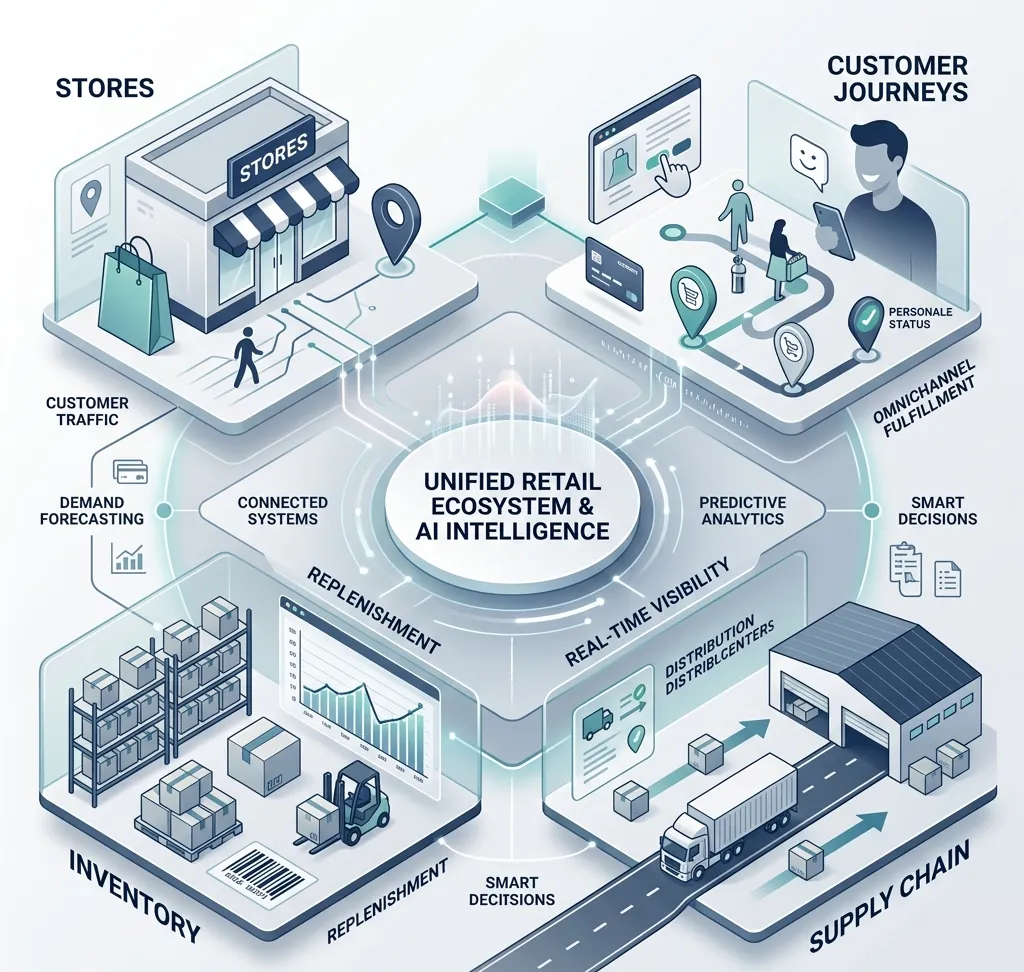
The Context Shaping Retail
Understanding the macro trends and digital priorities driving the need for AI transformation in your sector.
Industry Trends
- Shift towards hyper-personalized shopping experiences
- Rise of seamless omnichannel integration
- Automation of in-store tasks and checkout processes
- Sustainability-driven inventory practices
Digital Priorities
- Unified customer data platforms (CDP)
- Real-time inventory visibility
- AI-driven demand forecasting
- Augmented reality (AR) for virtual try-ons
AI Maturity
The retail sector exhibits moderate to high AI maturity. Leading enterprises heavily invest in predictive analytics and computer vision to optimize supply chains and personalize marketing, whereas smaller players are just beginning to adopt basic AI tools for inventory and customer service.
The Challenges Shaping the Future of Retail
Strategic barriers preventing organizations from scaling effectively, which AI is uniquely positioned to solve.
Supply Chain Volatility
Fluctuating demand and global disruptions make it difficult to maintain optimal inventory levels.
Customer Retention
High competition and low switching costs require brands to continuously innovate in loyalty and engagement.
Data Silos
Inability to aggregate data across physical stores, e-commerce, and mobile apps leads to fragmented customer views.
Margin Compression
Rising operational costs and aggressive pricing from competitors squeeze profit margins.
Where AI Creates the Greatest Business Impact
How enterprise AI capabilities directly address your core challenges to unlock new value and operational efficiency.
Hyper-Personalization
Leveraging generative AI to create customized product recommendations and marketing copy.
Automated Replenishment
AI models forecasting demand at the SKU level to automate inventory replenishment.
Visual Search & Discovery
Allowing customers to search for products using images, powered by computer vision.
Loss Prevention
Using AI-powered video analytics to detect and prevent theft at checkout and in store aisles.
High-Value AI Use Cases Across the Retail Value Chain
Proven applications driving measurable business value, efficiency, and transformation in Retail.
1Predictive Demand Forecasting
The Problem
Traditional forecasting methods fail to account for complex variables like weather, social trends, and local events, leading to stockouts or overstock.
The Outcome
20% reduction in excess inventory and 15% decrease in stockouts, significantly improving working capital.
Example Workflow
Machine learning models analyze historical sales, social media sentiment, and weather patterns to predict demand at the store and SKU level.
2Dynamic Pricing Optimization
The Problem
Static pricing strategies leave money on the table and fail to respond to competitor actions or demand shifts.
The Outcome
5-10% increase in revenue margins through real-time optimized pricing strategies.
Example Workflow
AI algorithms continuously adjust prices based on competitor pricing, inventory levels, time of day, and customer elasticity.
3Personalized Product Recommendations
The Problem
Generic recommendations lead to low conversion rates and poor customer engagement.
The Outcome
Up to 30% increase in average order value (AOV) and improved customer lifetime value (CLV).
Example Workflow
Deep learning models analyze browsing behavior and purchase history to surface highly relevant products in real-time.
4Automated Customer Support
The Problem
High volume of routine customer inquiries overwhelms support teams and leads to long wait times.
The Outcome
Resolution of 70% of tier-1 support queries without human intervention, reducing support costs.
Example Workflow
Generative AI-powered chatbots handle order tracking, returns, and FAQs with natural language understanding.
5Visual Search for E-Commerce
The Problem
Customers struggle to find products using text queries when they have a visual reference.
The Outcome
Higher engagement rates and a smoother path to purchase for visually-driven products.
Example Workflow
Computer vision systems allow shoppers to upload a photo and instantly find similar apparel or home goods.
6Supply Chain Route Optimization
The Problem
Inefficient delivery routes result in high fuel costs, delays, and poor customer satisfaction.
The Outcome
15% reduction in transportation costs and faster last-mile delivery times.
Example Workflow
AI analyzes traffic, weather, and delivery windows to dynamically route fleet vehicles.
7Fraud Detection in E-Commerce
The Problem
Rising rates of friendly fraud and account takeovers cause significant financial losses.
The Outcome
Reduction of chargebacks by 40% with minimal impact on legitimate transactions.
Example Workflow
Anomaly detection models evaluate hundreds of data points (IP, behavior, velocity) in milliseconds to block fraudulent orders.
8Store Layout Optimization
The Problem
Suboptimal store layouts fail to maximize foot traffic and cross-selling opportunities.
The Outcome
Increased sales per square foot and optimized product placement.
Example Workflow
Computer vision analyzes anonymized customer flow through the store to recommend optimal aisle arrangements.
9Automated Checkout (Cashierless Stores)
The Problem
Long checkout lines lead to cart abandonment and poor customer experience.
The Outcome
Frictionless shopping experience and reallocation of staff to customer service roles.
Example Workflow
Sensor fusion and computer vision track items taken from shelves and automatically charge the customer's account.
10Generative AI Marketing Copy
The Problem
Creating thousands of product descriptions and personalized emails is slow and resource-intensive.
The Outcome
10x faster content generation and improved A/B testing variations.
Example Workflow
LLMs generate SEO-optimized product descriptions and customized email campaigns based on brand voice guidelines.
11Virtual Try-On
The Problem
High return rates in online apparel shopping due to sizing and fit issues.
The Outcome
25% reduction in return rates and higher conversion rates.
Example Workflow
Augmented reality and AI map clothing onto the user's uploaded photo or live camera feed.
12Workforce Scheduling Optimization
The Problem
Over- or under-staffing leads to unnecessary labor costs or poor customer service.
The Outcome
Optimized labor spend and improved employee satisfaction through predictable scheduling.
Example Workflow
AI forecasts foot traffic and transaction volumes to automatically generate optimal staff schedules.
13Supplier Risk Management
The Problem
Lack of visibility into supplier health leads to unexpected supply chain disruptions.
The Outcome
Proactive mitigation of supply chain risks and reduced downtime.
Example Workflow
NLP models scan news, financial reports, and social media to assess and score supplier risk in real-time.
Risk & Governance
Building Responsible and Trusted AI
Retailers must balance personalization with privacy, ensuring customer data is collected, stored, and used in compliance with data protection laws. AI systems, particularly those used for dynamic pricing and facial recognition (in-store), require strict ethical guidelines to prevent bias and discrimination. Synottic's Responsible AI frameworks ensure that your deployments meet critical standards for security, privacy, and fairness.
GDPR (General Data Protection Regulation)
CCPA/CPRA (California Consumer Privacy Act)
PCI DSS (Payment Card Industry Data Security Standard)
ISO/IEC 27001 (Information Security Management)
How Synottic Helps
- 1
AI Readiness Audit
We assess your data infrastructure and governance posture against Retail regulatory standards.
- 2
Guardrails Implementation
Deploy enterprise guardrails to prevent data leakage, bias, and hallucination.
- 3
Continuous Monitoring
Automated drift detection and bias auditing for production models to ensure ongoing compliance.
Your Recommended AI Capability Journey
A structured capability-building roadmap tailored for Retail professionals, from foundational literacy to enterprise-scale AI implementation.
1
Phase 1
Build Foundations
Understand AI terminology, concepts, and responsible use cases specific to Retail.
AI Literacy Essentials
1 - 3 Days
Skills Acquired
- Explain core AI concepts in simple business language
- Distinguish AI assistants, copilots, automation and agents
- Write effective prompts using structured frameworks
View Program
Generative AI Essentials
1 - 3 Days
Skills Acquired
- Explain Generative AI in practical business terms
- Understand LLMs and foundation models conceptually
- Select an appropriate AI tool for a given task
View Program
2
Phase 2
Develop Practical Skills
Master generative AI tools to improve daily productivity and communication in Retail.
3
Phase 3
Apply AI
Apply AI to function-specific workflows, operations, and strategic planning within Retail.
AI for Operations & Supply Chain
1 - 3 Days
Skills Acquired
- Understand AI concepts and practical applications in operations
- Use AI assistants to automate operational activities
- Improve demand forecasting and inventory planning
View Program
AI for Marketing
1 - 3 Days
Skills Acquired
- Understand AI applications across marketing functions
- Use AI assistants to improve daily marketing productivity
- Create effective prompts for content and campaigns
View Program
AI for Customer Service
1 - 3 Days
Skills Acquired
- Apply AI confidently across the customer service lifecycle
- Deliver faster, more personalized customer support
- Reduce response and resolution times using AI assistants
View Program
4
Phase 4
Govern & Scale
Deploy and govern secure, agentic AI systems that comply with Retail regulations.
Responsible AI Essentials
1 - 3 Days
Skills Acquired
- Apply Responsible AI principles in everyday work
- Identify and mitigate AI risks
- Evaluate AI systems for fairness and transparency
View Program
AI Agents Essentials
1 - 3 Days
Skills Acquired
- Understand enterprise Agentic AI architectures
- Design AI agent workflows
- Connect AI agents to enterprise systems
View Program
5
Phase 5
Enterprise Capability
Scale AI adoption and build internal capability across your entire Retail organization.
The Synottic Transformation Journey
A structured pathway from discovery through to continuous business value, ensuring lasting impact.
1
Discovery
2
Strategize
3
Enable
4
Govern
5
Deploy
6
Scale
How Synottic Helps You Succeed
End-to-end consulting and implementation services designed specifically for Retail.
AI Readiness Assessment
Measure organisational AI maturity and identify strategic capability gaps.
AI Strategy
Align AI initiatives with business goals and operational priorities to maximize ROI.
Executive Advisory
Support senior leaders with AI strategy and long-term transformation planning.
Capability Building
Train your workforce with tailored, role-based AI enablement programs.
Responsible AI & Governance
Establish policies, controls, and ethical frameworks to mitigate AI risks.
Agentic AI & Implementation
Design and deploy autonomous AI agents for complex enterprise processes.
Frequently Asked Questions
AI analyzes diverse datasets (sales history, weather, local events) to accurately predict demand, allowing retailers to optimize stock levels, reduce waste, and prevent stockouts.