Loading…
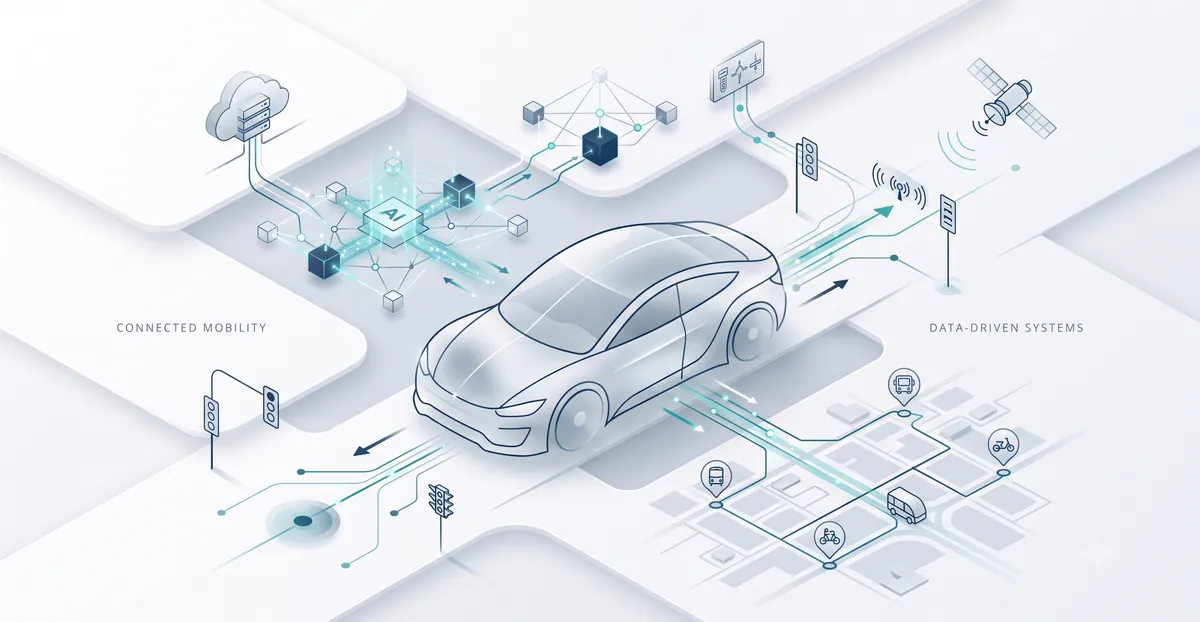
The Context Shaping Automotive
Understanding the macro trends and digital priorities driving the need for AI transformation in your sector.
Industry Trends
- Transition from internal combustion engines (ICE) to Electric Vehicles (EVs)
- Development of Software-Defined Vehicles (SDVs)
- Progression towards Level 4 and Level 5 autonomous driving
- Shift towards direct-to-consumer sales and subscription models
Digital Priorities
- Accelerating product development cycles with digital twins and simulation
- Securing the connected car ecosystem against cyber threats
- Optimizing battery lifecycle management and charging infrastructure
- Implementing AI-driven quality control on the assembly line
AI Maturity
The automotive sector is at the bleeding edge of AI, particularly in computer vision for autonomous driving. Inside the factory, AI adoption is maturing rapidly in robotics, predictive maintenance, and quality inspection.
The Challenges Shaping the Future of Automotive
Strategic barriers preventing organizations from scaling effectively, which AI is uniquely positioned to solve.
Supply Chain Volatility
Managing shortages of critical components like semiconductors and battery materials.
Software Complexity
Transitioning from hardware-centric to software-defined vehicle architectures.
Quality Assurance
Maintaining zero-defect manufacturing standards in highly complex assemblies.
Capital Intensity
Balancing massive R&D investments in EVs/AVs while maintaining legacy ICE businesses.
Where AI Creates the Greatest Business Impact
How enterprise AI capabilities directly address your core challenges to unlock new value and operational efficiency.
Autonomous Navigation
Pioneering the future of mobility with self-driving technology.
Generative Design
Using AI to design lighter, stronger, and more aerodynamic components.
Predictive Quality
Catching defects on the assembly line before the vehicle is completed.
In-Car Personalization
Creating highly customized, voice-activated cabin experiences.
High-Value AI Use Cases Across the Automotive Value Chain
Proven applications driving measurable business value, efficiency, and transformation in Automotive.
1Advanced Driver Assistance Systems (ADAS) and Autonomous Driving
The Problem
Human error is the leading cause of traffic accidents, and driving is fatiguing.
The Outcome
Dramatically reduces collision rates and paves the way for fully autonomous mobility.
Example Workflow
Deep neural networks process data from cameras, LiDAR, and radar in real-time to detect pedestrians, read signs, and control steering and braking.
2AI-Driven Generative Design
The Problem
Traditional engineering design is iterative, slow, and often results in suboptimal weight-to-strength ratios.
The Outcome
Reduces component weight by 20% and accelerates the R&D design phase.
Example Workflow
Engineers input constraints (materials, load-bearing requirements) into AI software, which generates thousands of optimized design variations that humans wouldn't conceive.
3Computer Vision for Defect Detection
The Problem
Manual visual inspection of paint jobs and welds on the assembly line is inconsistent and misses micro-defects.
The Outcome
Improves defect detection rates to 99% and reduces scrap and rework costs.
Example Workflow
High-resolution cameras paired with CNNs (Convolutional Neural Networks) inspect every vehicle body for paint blemishes, panel gaps, and weld integrity in milliseconds.
4Predictive Maintenance for Factory Robotics
The Problem
A breakdown of a single robotic arm can halt the entire assembly line, costing thousands of dollars per minute.
The Outcome
Reduces unplanned factory downtime by up to 25%.
Example Workflow
IoT sensors on factory robots monitor vibration and torque. Machine learning predicts when a servo motor will fail, scheduling maintenance during planned shift changes.
5Battery Health and Lifecycle Management
The Problem
EV batteries degrade over time, and unpredictable failure leads to warranty claims and range anxiety.
The Outcome
Extends battery life and accurately predicts remaining useful life (RUL) for secondary markets.
Example Workflow
AI analyzes charging patterns, temperature history, and cell voltage over-the-air to optimize the Battery Management System (BMS) and prevent accelerated degradation.
6Intelligent Supply Chain Forecasting
The Problem
Automakers struggle to predict the demand for specific vehicle trims and the resulting need for millions of individual parts.
The Outcome
Reduces inventory carrying costs by 15% and mitigates parts shortages.
Example Workflow
AI models fuse macroeconomic data, dealership sales trends, and supplier lead times to optimize the bill of materials (BOM) ordering process.
7In-Cabin AI and Voice Assistants
The Problem
Clunky infotainment systems distract drivers and offer poor user experiences.
The Outcome
Enhances driver safety and provides a personalized, seamless cabin experience.
Example Workflow
Natural Language Processing enables conversational voice control for navigation and climate, while cabin cameras detect driver drowsiness and trigger alerts.
8Over-the-Air (OTA) Predictive Diagnostics
The Problem
Recalls and dealer diagnostic visits are expensive for OEMs and inconvenient for owners.
The Outcome
Reduces warranty costs by 15% and improves customer satisfaction.
Example Workflow
Vehicles stream telemetry data to the cloud where AI detects anomalies (e.g., erratic transmission behavior) and pushes software fixes OTA before a physical failure occurs.
9Demand Modeling for EV Charging Infrastructure
The Problem
Deploying EV charging networks is capital intensive; placing them in low-utilization areas wastes resources.
The Outcome
Maximizes ROI on charging station deployment and reduces grid stress.
Example Workflow
AI models analyze traffic patterns, demographic data, and grid capacity to determine the optimal locations and charger speeds for new charging hubs.
10Smart Manufacturing Digital Twins
The Problem
Reconfiguring an assembly line for a new vehicle model requires expensive physical prototyping and trial-and-error.
The Outcome
Cuts time-to-market for new models and optimizes factory floor layout.
Example Workflow
A complete digital twin of the factory uses reinforcement learning to simulate and optimize robot pathways and human ergonomics before any physical equipment is moved.
11Dynamic Pricing for Used Vehicles
The Problem
Pricing trade-ins and used cars accurately is difficult due to varying conditions and local market fluctuations.
The Outcome
Increases profit margins on used car sales and speeds up inventory turnover.
Example Workflow
AI analyzes market demand, historical auction prices, and vehicle condition reports to generate real-time, optimal pricing for dealerships.
12Warranty Fraud Detection
The Problem
Fraudulent or inflated warranty claims from service centers cost OEMs millions annually.
The Outcome
Identifies and blocks 10-20% of fraudulent warranty payouts.
Example Workflow
Machine learning algorithms scan thousands of warranty claims to identify anomalous patterns, such as a dealership replacing specific parts at a statistically improbable rate.
Risk & Governance
Building Responsible and Trusted AI
Automotive AI governance is heavily focused on the safety and validation of autonomous driving systems, alongside strict data privacy rules regarding the telemetry and location data generated by connected vehicles. Synottic's Responsible AI frameworks ensure that your deployments meet critical standards for security, privacy, and fairness.
ISO 26262 (Functional Safety for Road Vehicles)
ISO/SAE 21434 (Cybersecurity engineering for road vehicles)
UNECE WP.29 regulations on software updates and cybersecurity
GDPR and CCPA for connected car data privacy
How Synottic Helps
- 1
AI Readiness Audit
We assess your data infrastructure and governance posture against Automotive regulatory standards.
- 2
Guardrails Implementation
Deploy enterprise guardrails to prevent data leakage, bias, and hallucination.
- 3
Continuous Monitoring
Automated drift detection and bias auditing for production models to ensure ongoing compliance.
Your Recommended AI Capability Journey
A structured capability-building roadmap tailored for Automotive professionals, from foundational literacy to enterprise-scale AI implementation.
1
Phase 1
Build Foundations
Understand AI terminology, concepts, and responsible use cases specific to Automotive.
2
Phase 2
Develop Practical Skills
Master generative AI tools to improve daily productivity and communication in Automotive.
3
Phase 3
Apply AI
Apply AI to function-specific workflows, operations, and strategic planning within Automotive.
AI for Operations & Supply Chain
1 - 3 Days
Skills Acquired
- Understand AI concepts and practical applications in operations
- Use AI assistants to automate operational activities
- Improve demand forecasting and inventory planning
View Program
AI for Procurement
1 - 3 Days
Skills Acquired
- Understand AI concepts relevant to procurement and supply chain
- Apply Prompt Engineering to procurement workflows
- Generate procurement documentation, RFQs, RFPs and communications
View Program
4
Phase 4
Govern & Scale
Deploy and govern secure, agentic AI systems that comply with Automotive regulations.
5
Phase 5
Enterprise Capability
Scale AI adoption and build internal capability across your entire Automotive organization.
The Synottic Transformation Journey
A structured pathway from discovery through to continuous business value, ensuring lasting impact.
1
Discovery
2
Strategize
3
Enable
4
Govern
5
Deploy
6
Scale
How Synottic Helps You Succeed
End-to-end consulting and implementation services designed specifically for Automotive.
AI Readiness Assessment
Measure organisational AI maturity and identify strategic capability gaps.
AI Strategy
Align AI initiatives with business goals and operational priorities to maximize ROI.
Executive Advisory
Support senior leaders with AI strategy and long-term transformation planning.
Capability Building
Train your workforce with tailored, role-based AI enablement programs.
Responsible AI & Governance
Establish policies, controls, and ethical frameworks to mitigate AI risks.
Agentic AI & Implementation
Design and deploy autonomous AI agents for complex enterprise processes.
Frequently Asked Questions
AI, specifically deep learning, allows the car to 'see' and understand its environment. It processes massive amounts of data from cameras and radar to identify objects, predict their movement, and make real-time steering and braking decisions.