Loading…
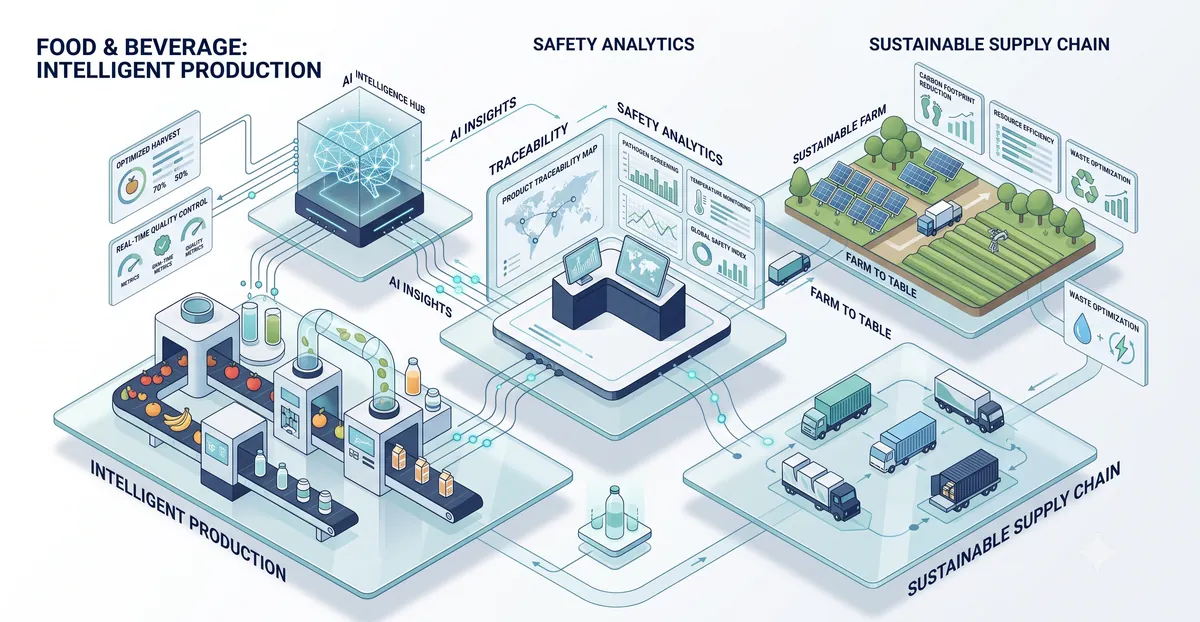
The Context Shaping Food & Beverage
Understanding the macro trends and digital priorities driving the need for AI transformation in your sector.
Industry Trends
- Rising consumer demand for plant-based and sustainable products
- Increased focus on end-to-end supply chain transparency and traceability
- Shift towards personalized nutrition and functional foods
- Automation of food processing to combat labor shortages
Digital Priorities
- Implementing blockchain and AI for farm-to-fork traceability
- Using digital twins for process optimization in manufacturing
- Leveraging consumer data for localized product assortment
- Automating quality inspection with computer vision
AI Maturity
The F&B industry is actively adopting AI. While front-end marketing and demand forecasting are relatively mature, the use of AI in core formulation (R&D) and precision agriculture is rapidly accelerating.
The Challenges Shaping the Future of Food & Beverage
Strategic barriers preventing organizations from scaling effectively, which AI is uniquely positioned to solve.
Perishability and Waste
Managing short shelf lives and reducing food waste across the supply chain.
Stringent Safety Standards
Ensuring absolute compliance with food safety regulations to prevent recalls.
Commodity Price Volatility
Protecting margins against fluctuating costs of raw agricultural inputs.
Changing Consumer Tastes
Keeping pace with rapid shifts in dietary preferences and health trends.
Where AI Creates the Greatest Business Impact
How enterprise AI capabilities directly address your core challenges to unlock new value and operational efficiency.
Waste Reduction
Optimizing inventory and production to dramatically cut food spoilage.
Accelerated R&D
Using AI to discover new flavor profiles and ingredient substitutions.
Precision Farming Integration
Connecting raw material sourcing with AI-driven agricultural yields.
Automated Quality Assurance
Ensuring 100% product consistency and safety through visual AI.
High-Value AI Use Cases Across the Food & Beverage Value Chain
Proven applications driving measurable business value, efficiency, and transformation in Food & Beverage.
1Demand Forecasting for Perishables
The Problem
Inaccurate forecasting leads to massive food waste (spoilage) or costly out-of-stock scenarios.
The Outcome
Reduces food waste by 15-20% and improves on-shelf availability.
Example Workflow
AI models combine historical sales, local weather forecasts, local events, and shelf-life data to generate highly accurate, daily store-level replenishment orders.
2AI-Driven Product Formulation and R&D
The Problem
Developing new flavors or substituting ingredients (e.g., replacing sugar) takes months of trial and error.
The Outcome
Cuts R&D cycle times by 30% and increases product success rates.
Example Workflow
Generative AI analyzes millions of flavor compounds, consumer reviews, and recipes to predict winning flavor combinations and simulate ingredient interactions.
3Computer Vision for Quality and Sorting
The Problem
Manual sorting of raw agricultural products (e.g., fruits, grains) is slow and results in inconsistent quality.
The Outcome
Increases sorting speed by 50% and ensures uniform product quality.
Example Workflow
High-speed cameras and deep learning algorithms inspect items on a conveyor belt, instantly identifying and using air jets to remove defective, bruised, or foreign materials.
4Supply Chain Traceability and Fraud Detection
The Problem
Food fraud (e.g., mislabeling organic products) and opaque supply chains lead to safety risks and loss of consumer trust.
The Outcome
Enables instant farm-to-fork traceability and protects brand integrity.
Example Workflow
AI analyzes supply chain data and documentation to detect anomalies indicating food fraud, while providing consumers with transparent origin data via QR codes.
5Predictive Maintenance in Food Processing
The Problem
Unexpected breakdowns in processing plants lead to complete batches of food being ruined due to temperature deviations.
The Outcome
Reduces unexpected equipment failure by 25% and saves batches from spoilage.
Example Workflow
IoT sensors on industrial ovens and refrigeration units feed data to AI models that predict part failures, allowing for maintenance during scheduled sanitation shifts.
6Dynamic Pricing and Markdown Optimization
The Problem
Static pricing fails to incentivize the sale of perishable goods before they reach their expiration date.
The Outcome
Increases revenue recovery on perishables and reduces shrink by 20%.
Example Workflow
AI dynamically adjusts the price of items based on their remaining shelf life, current inventory levels, and historical price elasticity, automatically updating electronic shelf labels.
7Automated Recipe Management in Manufacturing
The Problem
Variations in raw agricultural ingredients (e.g., moisture content in flour) cause inconsistencies in the final manufactured product.
The Outcome
Ensures 100% batch consistency and reduces raw material waste.
Example Workflow
AI continuously monitors the characteristics of incoming ingredients and automatically micro-adjusts the manufacturing recipe (e.g., baking time, water addition) in real-time.
8Consumer Sentiment Analysis for Trend Spotting
The Problem
F&B companies often miss emerging food trends, losing market share to agile startups.
The Outcome
Identifies micro-trends months before they hit mainstream, informing strategy.
Example Workflow
NLP algorithms scrape social media, food blogs, and restaurant menus globally to detect rising interest in novel ingredients (e.g., specific adaptogens or plant proteins).
9Energy and Water Optimization in Plants
The Problem
Food and beverage manufacturing is highly resource-intensive, consuming massive amounts of water and energy.
The Outcome
Reduces energy and water consumption by 10-15%, aiding sustainability goals.
Example Workflow
AI optimizes the operation of boilers, chillers, and CIP (Clean-in-Place) systems based on production schedules, minimizing resource usage without compromising hygiene.
10Personalized Nutrition Recommendations
The Problem
Consumers are overwhelmed by generic dietary advice and struggle to find products matching their specific health goals.
The Outcome
Increases customer loyalty and direct-to-consumer sales.
Example Workflow
AI engines power mobile apps that analyze a user's health metrics, DNA data, or dietary preferences to recommend specific food products or customized meal plans.
11Yield Prediction for Agricultural Sourcing
The Problem
F&B manufacturers face price volatility and supply shortages due to unpredictable crop yields.
The Outcome
Improves hedging strategies and ensures stable raw material supply.
Example Workflow
AI analyzes satellite imagery, soil sensors, and meteorological data to accurately predict the yield of contracted farms months before the harvest.
12Automated Compliance and Safety Auditing
The Problem
Ensuring compliance with FDA or EFSA regulations across multiple facilities is a massive administrative burden.
The Outcome
Reduces audit preparation time by 40% and mitigates the risk of fines.
Example Workflow
AI systems automatically parse changing regulations and cross-reference them against factory sensor data and digital logs to flag potential compliance violations in real-time.
Risk & Governance
Building Responsible and Trusted AI
Governance in the Food & Beverage industry centers heavily on consumer safety and regulatory compliance. AI systems must ensure traceability and adherence to strict food safety standards, while models used in personalized nutrition must protect sensitive health data. Synottic's Responsible AI frameworks ensure that your deployments meet critical standards for security, privacy, and fairness.
FSMA (Food Safety Modernization Act) compliance
HACCP (Hazard Analysis Critical Control Point) integration
FDA/EFSA regulations for food safety and labeling
GDPR/HIPAA for consumer data in personalized nutrition apps
How Synottic Helps
- 1
AI Readiness Audit
We assess your data infrastructure and governance posture against Food & Beverage regulatory standards.
- 2
Guardrails Implementation
Deploy enterprise guardrails to prevent data leakage, bias, and hallucination.
- 3
Continuous Monitoring
Automated drift detection and bias auditing for production models to ensure ongoing compliance.
Your Recommended AI Capability Journey
A structured capability-building roadmap tailored for Food & Beverage professionals, from foundational literacy to enterprise-scale AI implementation.
1
Phase 1
Build Foundations
Understand AI terminology, concepts, and responsible use cases specific to Food Beverage.
AI Literacy Essentials
1 - 3 Days
Skills Acquired
- Explain core AI concepts in simple business language
- Distinguish AI assistants, copilots, automation and agents
- Write effective prompts using structured frameworks
View Program
Generative AI Essentials
1 - 3 Days
Skills Acquired
- Explain Generative AI in practical business terms
- Understand LLMs and foundation models conceptually
- Select an appropriate AI tool for a given task
View Program
2
Phase 2
Develop Practical Skills
Master generative AI tools to improve daily productivity and communication in Food Beverage.
3
Phase 3
Apply AI
Apply AI to function-specific workflows, operations, and strategic planning within Food Beverage.
AI for Operations & Supply Chain
1 - 3 Days
Skills Acquired
- Understand AI concepts and practical applications in operations
- Use AI assistants to automate operational activities
- Improve demand forecasting and inventory planning
View Program
AI for Marketing
1 - 3 Days
Skills Acquired
- Understand AI applications across marketing functions
- Use AI assistants to improve daily marketing productivity
- Create effective prompts for content and campaigns
View Program
AI for Customer Service
1 - 3 Days
Skills Acquired
- Apply AI confidently across the customer service lifecycle
- Deliver faster, more personalized customer support
- Reduce response and resolution times using AI assistants
View Program
4
Phase 4
Govern & Scale
Deploy and govern secure, agentic AI systems that comply with Food Beverage regulations.
Responsible AI Essentials
1 - 3 Days
Skills Acquired
- Apply Responsible AI principles in everyday work
- Identify and mitigate AI risks
- Evaluate AI systems for fairness and transparency
View Program
AI Agents Essentials
1 - 3 Days
Skills Acquired
- Understand enterprise Agentic AI architectures
- Design AI agent workflows
- Connect AI agents to enterprise systems
View Program
5
Phase 5
Enterprise Capability
Scale AI adoption and build internal capability across your entire Food Beverage organization.
The Synottic Transformation Journey
A structured pathway from discovery through to continuous business value, ensuring lasting impact.
1
Discovery
2
Strategize
3
Enable
4
Govern
5
Deploy
6
Scale
How Synottic Helps You Succeed
End-to-end consulting and implementation services designed specifically for Food & Beverage.
AI Readiness Assessment
Measure organisational AI maturity and identify strategic capability gaps.
AI Strategy
Align AI initiatives with business goals and operational priorities to maximize ROI.
Executive Advisory
Support senior leaders with AI strategy and long-term transformation planning.
Capability Building
Train your workforce with tailored, role-based AI enablement programs.
Responsible AI & Governance
Establish policies, controls, and ethical frameworks to mitigate AI risks.
Agentic AI & Implementation
Design and deploy autonomous AI agents for complex enterprise processes.
Frequently Asked Questions
Yes. AI can analyze vast databases of chemical flavor compounds and consumer preferences to suggest novel, successful flavor combinations much faster than traditional trial-and-error R&D.