Loading…
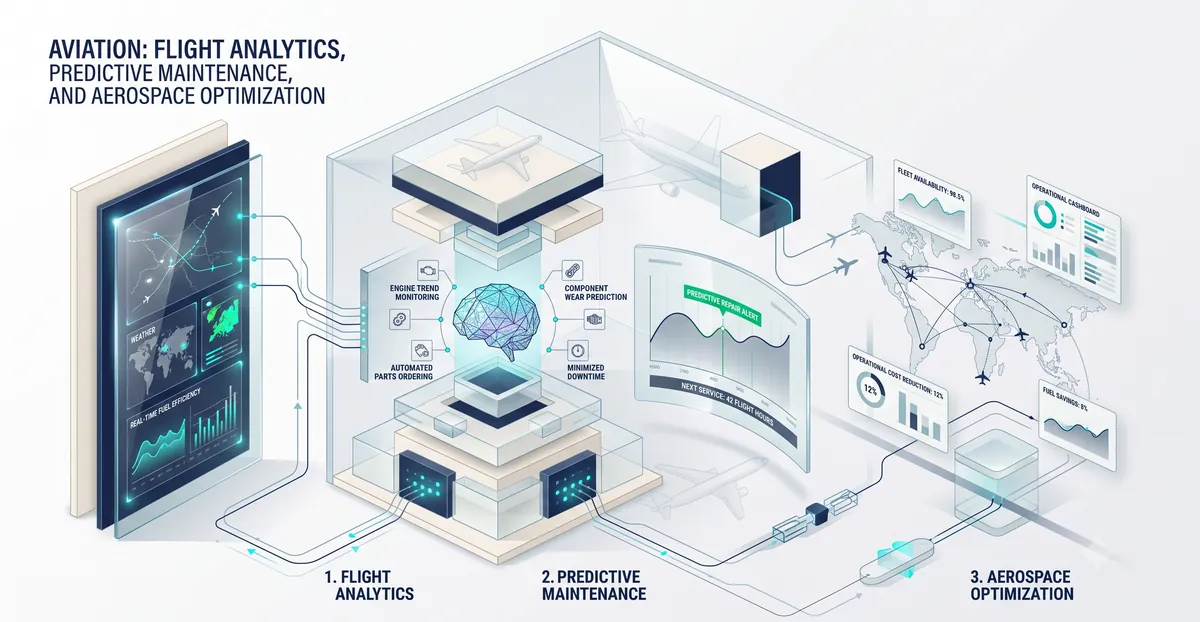
The Context Shaping Aviation
Understanding the macro trends and digital priorities driving the need for AI transformation in your sector.
Industry Trends
- Push towards Sustainable Aviation Fuel (SAF) and zero-emission aircraft
- Increasing airspace complexity with the integration of drones and eVTOLs
- Biometric passenger processing for seamless airport journeys
- Digital twin technology for aircraft lifecycle management
Digital Priorities
- Modernizing legacy IT systems and breaking down data silos
- Implementing advanced predictive maintenance programs
- Enhancing cybersecurity for connected aircraft systems
- Optimizing network planning and fleet utilization
AI Maturity
Aviation is a pioneer in operations research and automation (e.g., autopilots). The industry is now advancing to deep AI integration, particularly in predictive maintenance and dynamic network optimization, though heavily gated by safety regulations.
The Challenges Shaping the Future of Aviation
Strategic barriers preventing organizations from scaling effectively, which AI is uniquely positioned to solve.
Operational Disruptions
Managing the cascading effects of weather, ATC delays, and crew shortages.
High Operational Costs
Combating volatile fuel prices and expensive maintenance procedures.
Stringent Regulations
Ensuring all AI systems meet rigorous safety and certification standards.
Sustainability Mandates
Meeting aggressive industry targets to reach net-zero carbon emissions.
Where AI Creates the Greatest Business Impact
How enterprise AI capabilities directly address your core challenges to unlock new value and operational efficiency.
Fuel Optimization
Reducing fuel burn through AI-optimized flight paths and altitudes.
Predictive MRO
Shifting from scheduled maintenance to condition-based interventions.
Resilient Scheduling
Rapidly recovering from disruptions using AI-driven scenario planning.
Seamless Passenger Flow
Using computer vision and biometrics to speed up airport processing.
High-Value AI Use Cases Across the Aviation Value Chain
Proven applications driving measurable business value, efficiency, and transformation in Aviation.
1Predictive Aircraft Maintenance (MRO)
The Problem
Unscheduled maintenance causes Aircraft on Ground (AOG) events, leading to massive delays and revenue loss.
The Outcome
Reduces AOG events by 20-30% and optimizes spare parts inventory.
Example Workflow
AI models analyze terabytes of telemetry data from aircraft sensors (engine temperature, vibration) to predict component failures days before they occur, allowing repairs during scheduled downtime.
2Flight Path and Fuel Optimization
The Problem
Suboptimal flight routes and altitudes result in excessive fuel consumption and carbon emissions.
The Outcome
Reduces fuel burn by 1-3% per flight, saving millions annually and cutting emissions.
Example Workflow
Machine learning algorithms process live weather data, wind patterns, and air traffic constraints to recommend the most fuel-efficient 4D trajectory to pilots in real-time.
3Irregular Operations (IRROPS) Recovery
The Problem
Severe weather or ATC outages cause massive network disruptions that human dispatchers struggle to resolve quickly.
The Outcome
Cuts recovery time by 50% and minimizes passenger cancellations.
Example Workflow
AI optimization engines rapidly generate thousands of scenarios to reassign aircraft and rebook passengers optimally following a major hub closure.
4Dynamic Network Planning
The Problem
Deciding which routes to fly and which aircraft to assign months in advance is highly risky due to demand volatility.
The Outcome
Increases network profitability by 3-5% through optimized capacity allocation.
Example Workflow
Deep learning models forecast route-level demand using macroeconomic indicators, search trends, and historical data to optimize the airline's long-term schedule.
5Biometric Passenger Processing
The Problem
Manual identity checks at check-in, security, and boarding cause bottlenecks and degrade the passenger experience.
The Outcome
Reduces boarding times by 30% and enhances security accuracy.
Example Workflow
Computer vision and facial recognition AI enable a 'seamless journey' where passengers walk from the curb to the aircraft without presenting physical documents.
6Turnaround Time (TAT) Optimization
The Problem
Inefficient aircraft turnarounds at the gate lead to accumulated delays and poor asset utilization.
The Outcome
Reduces average turnaround time by 3-5 minutes, allowing higher daily aircraft utilization.
Example Workflow
Computer vision cameras monitor the apron to track the progress of catering, fueling, and baggage loading, alerting ramp managers to delays in real-time.
7Air Traffic Flow Management
The Problem
Air traffic controllers rely on legacy tools to manage increasingly crowded airspace, leading to congestion and holding patterns.
The Outcome
Increases airspace capacity and reduces holding pattern delays by 15%.
Example Workflow
AI assists Air Navigation Service Providers (ANSPs) by predicting sector congestion hours in advance and suggesting minor speed adjustments to aircraft to sequence arrivals smoothly.
8Dynamic Pricing and Offer Management
The Problem
Traditional revenue management systems struggle to price ancillary services (bags, seats, meals) dynamically.
The Outcome
Increases ancillary revenue per passenger by 10-20%.
Example Workflow
AI models generate personalized bundles and price points for ancillaries in real-time based on the traveler's context, loyalty status, and willingness to pay.
9Cognitive Assistants for Pilots
The Problem
Pilots face cognitive overload during emergencies or complex procedures, increasing the risk of human error.
The Outcome
Enhances flight safety and reduces pilot workload during critical phases of flight.
Example Workflow
AI acts as a digital co-pilot, monitoring aircraft state and procedure checklists, and using natural language processing to alert crews to deviations or provide rapid access to manuals.
10Baggage Image Analysis for Security
The Problem
Human screeners suffer from fatigue, leading to inconsistent threat detection in X-ray images.
The Outcome
Improves threat detection rates while reducing false alarms and passenger wait times.
Example Workflow
Deep learning computer vision models automatically analyze 3D CT scans of cabin baggage to highlight potential weapons or explosives for the human screener.
11Spare Parts Inventory Forecasting
The Problem
Overstocking aviation parts ties up capital, while understocking leads to costly AOG situations.
The Outcome
Reduces inventory carrying costs by 15% while improving part availability.
Example Workflow
AI combines predictive maintenance forecasts with global supply chain data to dynamically position rotable parts at the right hubs just-in-time.
12Cabin Crew Sentiment and Feedback Analysis
The Problem
Airlines struggle to rapidly process post-flight reports from crew to identify recurring service or safety issues.
The Outcome
Accelerates issue resolution from weeks to days, improving safety culture.
Example Workflow
NLP models read thousands of free-text cabin crew reports to identify emerging trends, such as recurring issues with specific catering equipment or passenger behavioral problems.
Risk & Governance
Building Responsible and Trusted AI
Aviation is one of the most strictly regulated industries globally. AI systems, especially those impacting flight critical systems or aircraft maintenance, must undergo rigorous certification processes to guarantee safety and determinism. Synottic's Responsible AI frameworks ensure that your deployments meet critical standards for security, privacy, and fairness.
EASA AI Roadmap and FAA guidelines on machine learning in aviation
DO-178C (Software Considerations in Airborne Systems)
ICAO (International Civil Aviation Organization) cybersecurity frameworks
GDPR and regional laws for passenger biometric data
How Synottic Helps
- 1
AI Readiness Audit
We assess your data infrastructure and governance posture against Aviation regulatory standards.
- 2
Guardrails Implementation
Deploy enterprise guardrails to prevent data leakage, bias, and hallucination.
- 3
Continuous Monitoring
Automated drift detection and bias auditing for production models to ensure ongoing compliance.
Your Recommended AI Capability Journey
A structured capability-building roadmap tailored for Aviation professionals, from foundational literacy to enterprise-scale AI implementation.
1
Phase 1
Build Foundations
Understand AI terminology, concepts, and responsible use cases specific to Aviation.
AI Literacy Essentials
1 - 3 Days
Skills Acquired
- Explain core AI concepts in simple business language
- Distinguish AI assistants, copilots, automation and agents
- Write effective prompts using structured frameworks
View Program
Generative AI Essentials
1 - 3 Days
Skills Acquired
- Explain Generative AI in practical business terms
- Understand LLMs and foundation models conceptually
- Select an appropriate AI tool for a given task
View Program
2
Phase 2
Develop Practical Skills
Master generative AI tools to improve daily productivity and communication in Aviation.
3
Phase 3
Apply AI
Apply AI to function-specific workflows, operations, and strategic planning within Aviation.
AI for Operations & Supply Chain
1 - 3 Days
Skills Acquired
- Understand AI concepts and practical applications in operations
- Use AI assistants to automate operational activities
- Improve demand forecasting and inventory planning
View Program
AI for Marketing
1 - 3 Days
Skills Acquired
- Understand AI applications across marketing functions
- Use AI assistants to improve daily marketing productivity
- Create effective prompts for content and campaigns
View Program
AI for Customer Service
1 - 3 Days
Skills Acquired
- Apply AI confidently across the customer service lifecycle
- Deliver faster, more personalized customer support
- Reduce response and resolution times using AI assistants
View Program
4
Phase 4
Govern & Scale
Deploy and govern secure, agentic AI systems that comply with Aviation regulations.
Responsible AI Essentials
1 - 3 Days
Skills Acquired
- Apply Responsible AI principles in everyday work
- Identify and mitigate AI risks
- Evaluate AI systems for fairness and transparency
View Program
AI Agents Essentials
1 - 3 Days
Skills Acquired
- Understand enterprise Agentic AI architectures
- Design AI agent workflows
- Connect AI agents to enterprise systems
View Program
5
Phase 5
Enterprise Capability
Scale AI adoption and build internal capability across your entire Aviation organization.
The Synottic Transformation Journey
A structured pathway from discovery through to continuous business value, ensuring lasting impact.
1
Discovery
2
Strategize
3
Enable
4
Govern
5
Deploy
6
Scale
How Synottic Helps You Succeed
End-to-end consulting and implementation services designed specifically for Aviation.
AI Readiness Assessment
Measure organisational AI maturity and identify strategic capability gaps.
AI Strategy
Align AI initiatives with business goals and operational priorities to maximize ROI.
Executive Advisory
Support senior leaders with AI strategy and long-term transformation planning.
Capability Building
Train your workforce with tailored, role-based AI enablement programs.
Responsible AI & Governance
Establish policies, controls, and ethical frameworks to mitigate AI risks.
Agentic AI & Implementation
Design and deploy autonomous AI agents for complex enterprise processes.
Frequently Asked Questions
In the foreseeable future, AI will act to augment human pilots, not replace them entirely. AI will handle complex optimizations and monitor systems, acting as a highly capable 'digital co-pilot' while human pilots retain ultimate authority and handle exceptions.