Loading…
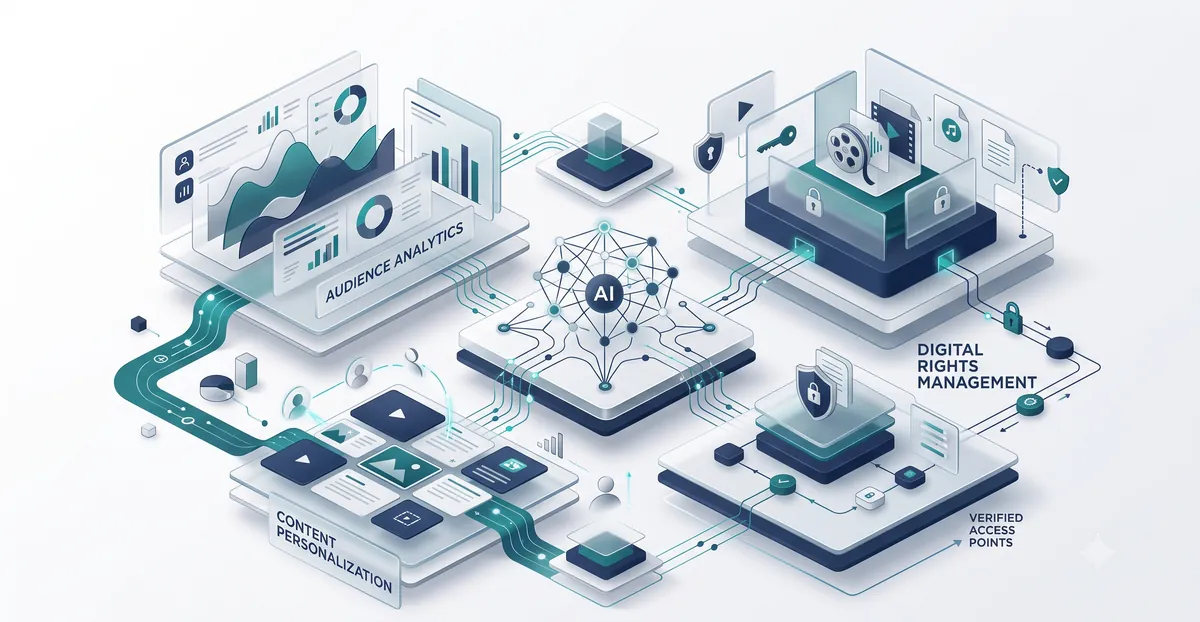
The Context Shaping Media & Entertainment
Understanding the macro trends and digital priorities driving the need for AI transformation in your sector.
Industry Trends
- Explosive growth in generative AI for scriptwriting, storyboarding, and VFX.
- Shift towards dynamic, AI-driven programmatic advertising.
- Rise of synthetic media and virtual influencers.
- Increasing reliance on AI for localized content dubbing and subtitling.
Digital Priorities
- Modernize content supply chains to integrate AI at every production stage.
- Enhance data privacy frameworks to secure user consumption data.
- Develop strategies to protect intellectual property in the generative AI era.
- Build robust recommendation engines capable of handling massive concurrency.
AI Maturity
The Media & Entertainment sector is a rapid adopter of AI, particularly on the consumer-facing side (recommendation engines). However, the integration of generative AI into the creative production process is currently causing significant industry disruption, forcing rapid maturity in legal and operational frameworks.
The Challenges Shaping the Future of Media & Entertainment
Strategic barriers preventing organizations from scaling effectively, which AI is uniquely positioned to solve.
Content Saturation
Intense competition for audience attention in an increasingly fragmented digital landscape.
Subscriber Churn
High rates of user cancellation in subscription video-on-demand (SVOD) services.
Production Costs
Escalating budgets for high-quality VFX, localization, and marketing campaigns.
Copyright & IP Risks
Navigating the complex legal landscape of AI-generated content and copyright infringement.
Where AI Creates the Greatest Business Impact
How enterprise AI capabilities directly address your core challenges to unlock new value and operational efficiency.
Predictive Hit-Making
Using AI to analyze scripts and social trends to predict audience reception before production begins.
Frictionless Localization
Automated, emotionally-aware dubbing allowing content to reach global markets instantly.
Interactive Storytelling
AI-driven narratives that adapt in real-time based on viewer choices and emotional responses.
Dynamic Monetization
Real-time, context-aware product placement and ad insertion in streaming video.
High-Value AI Use Cases Across the Media & Entertainment Value Chain
Proven applications driving measurable business value, efficiency, and transformation in Media & Entertainment.
1AI-Assisted Scriptwriting and Storyboarding
The Problem
The early stages of creative development are time-consuming and heavily reliant on iterative manual drafting.
The Outcome
Reduced pre-production timelines by 30%, allowing creators to iterate on concepts faster.
Example Workflow
Writers use LLMs to generate dialogue options, plot outlines, and character bios, while generative image models instantly create visual storyboards from text prompts.
2Predictive Subscriber Churn Modeling
The Problem
Streaming platforms lose millions in revenue due to unpredictable subscriber cancellations.
The Outcome
Reduced churn by 15% through proactive, targeted retention campaigns.
Example Workflow
Machine learning models analyze viewing habits, login frequency, and customer service interactions to flag users at high risk of canceling, automatically triggering personalized discount offers.
3Hyper-Personalized Content Recommendations
The Problem
Users face 'decision paralysis' when confronted with massive content libraries, leading to platform abandonment.
The Outcome
Increased average viewing time per session by 25% and boosted long-term retention.
Example Workflow
Deep learning algorithms analyze implicit signals (pause/rewind behavior) and explicit ratings to serve highly individualized home screens and 'next up' suggestions.
4Automated Video Localization and Dubbing
The Problem
Traditional dubbing and subtitling for global markets is expensive and delays international release windows.
The Outcome
Cut localization costs by 50% and enabled simultaneous global premieres.
Example Workflow
AI voice cloning and lip-sync technology translate and generate audio tracks in 40+ languages, adjusting the actors' lip movements on-screen to match the localized audio.
5Generative VFX and De-aging
The Problem
Visual effects, particularly altering human faces, are notoriously labor-intensive and expensive.
The Outcome
VFX budgets reduced by 20% with faster turnaround times for complex shots.
Example Workflow
Neural networks are used to seamlessly de-age actors or replace stunt doubles' faces with the lead actors' faces, requiring a fraction of the time of traditional CGI techniques.
6Automated Content Tagging and Metadata Generation
The Problem
Manually tagging vast archives of video/audio assets for searchability is slow and often inconsistent.
The Outcome
Improved internal asset discoverability by 80% and enhanced user search accuracy.
Example Workflow
Computer vision and NLP models scan video files to automatically generate timestamps, detect objects, identify actors, and transcribe dialogue into searchable metadata tags.
7Predictive Box Office and Ratings Analytics
The Problem
Greenlighting a multi-million dollar production is historically a high-risk gamble based on gut instinct.
The Outcome
Improved ROI on content investments by 15% through data-backed greenlighting decisions.
Example Workflow
AI analyzes script themes, cast historical performance, and current social media sentiment to forecast opening weekend box office or streaming viewership numbers.
8Dynamic In-Video Advertising
The Problem
Pre-roll and mid-roll ads are often disruptive and irrelevant, leading to ad-blindness and low conversion.
The Outcome
Increased ad engagement rates by 35% and created new premium ad inventory.
Example Workflow
Computer vision identifies blank spaces in a video stream (e.g., a billboard in a city scene) and dynamically inserts targeted, contextually relevant advertisements in real-time.
9Automated Highlight Reel Generation
The Problem
Sports broadcasters and news organizations struggle to manually cut highlight packages quickly enough for social media.
The Outcome
Reduced time-to-publish for highlight clips from hours to seconds, maximizing social engagement.
Example Workflow
AI analyzes audio levels (crowd cheering) and visual cues (scoring graphics) in a live sports feed to automatically clip and publish the most exciting moments to Twitter/X and TikTok.
10Copyright Infringement Detection
The Problem
User-generated content platforms face massive legal liability from illegally uploaded copyrighted material.
The Outcome
Automated removal of 99% of copyrighted material before it is publicly viewable.
Example Workflow
Audio and video fingerprinting algorithms continuously scan user uploads against a massive database of registered intellectual property, instantly blocking or demonetizing infringing content.
11AI Music Generation for Background Scores
The Problem
Licensing music for lower-budget productions, podcasts, or social media content is expensive and legally complex.
The Outcome
Eliminated background music licensing costs and accelerated post-production audio mixing.
Example Workflow
Generative AI models create original, royalty-free background scores tailored to the specific emotional arc and timing of a video scene.
12Virtual Influencers and Synthetic Avatars
The Problem
Human influencers pose brand safety risks, have limited availability, and command high fees.
The Outcome
Created highly controllable, always-on brand ambassadors with 100% brand safety.
Example Workflow
Brands deploy 3D CGI influencers powered by LLMs to interact with fans on social media, host live streams, and model digital clothing 24/7.
13Dynamic Game Difficulty Adjustment
The Problem
Players abandon video games if they are either too difficult (frustrating) or too easy (boring).
The Outcome
Increased player retention and average playtime by 20%.
Example Workflow
In-game AI monitors a player's skill level, reaction times, and stress indicators, dynamically adjusting enemy AI tactics, puzzle complexity, and resource availability to maintain optimal engagement.
Risk & Governance
Building Responsible and Trusted AI
Governance in Media & Entertainment AI is currently centered around Intellectual Property (IP) rights, deepfake regulations, and ethical implications of generative AI on creative labor. Organizations must implement strict protocols regarding the provenance of training data to avoid copyright infringement and ensure fair compensation mechanisms for artists whose work informs AI models. Synottic's Responsible AI frameworks ensure that your deployments meet critical standards for security, privacy, and fairness.
WIPO Copyright Treaty (WCT)
EU AI Act (Transparency requirements for Generative AI)
Digital Millennium Copyright Act (DMCA)
SAG-AFTRA AI Agreements (Actor likeness protections)
GDPR (regarding user viewing data)
How Synottic Helps
- 1
AI Readiness Audit
We assess your data infrastructure and governance posture against Media & Entertainment regulatory standards.
- 2
Guardrails Implementation
Deploy enterprise guardrails to prevent data leakage, bias, and hallucination.
- 3
Continuous Monitoring
Automated drift detection and bias auditing for production models to ensure ongoing compliance.
Your Recommended AI Capability Journey
A structured capability-building roadmap tailored for Media & Entertainment professionals, from foundational literacy to enterprise-scale AI implementation.
1
Phase 1
Build Foundations
Understand AI terminology, concepts, and responsible use cases specific to Media Entertainment.
AI Literacy Essentials
1 - 3 Days
Skills Acquired
- Explain core AI concepts in simple business language
- Distinguish AI assistants, copilots, automation and agents
- Write effective prompts using structured frameworks
View Program
Generative AI Essentials
1 - 3 Days
Skills Acquired
- Explain Generative AI in practical business terms
- Understand LLMs and foundation models conceptually
- Select an appropriate AI tool for a given task
View Program
2
Phase 2
Develop Practical Skills
Master generative AI tools to improve daily productivity and communication in Media Entertainment.
3
Phase 3
Apply AI
Apply AI to function-specific workflows, operations, and strategic planning within Media Entertainment.
AI for Operations & Supply Chain
1 - 3 Days
Skills Acquired
- Understand AI concepts and practical applications in operations
- Use AI assistants to automate operational activities
- Improve demand forecasting and inventory planning
View Program
AI for Marketing
1 - 3 Days
Skills Acquired
- Understand AI applications across marketing functions
- Use AI assistants to improve daily marketing productivity
- Create effective prompts for content and campaigns
View Program
AI for Customer Service
1 - 3 Days
Skills Acquired
- Apply AI confidently across the customer service lifecycle
- Deliver faster, more personalized customer support
- Reduce response and resolution times using AI assistants
View Program
4
Phase 4
Govern & Scale
Deploy and govern secure, agentic AI systems that comply with Media Entertainment regulations.
Responsible AI Essentials
1 - 3 Days
Skills Acquired
- Apply Responsible AI principles in everyday work
- Identify and mitigate AI risks
- Evaluate AI systems for fairness and transparency
View Program
AI Agents Essentials
1 - 3 Days
Skills Acquired
- Understand enterprise Agentic AI architectures
- Design AI agent workflows
- Connect AI agents to enterprise systems
View Program
5
Phase 5
Enterprise Capability
Scale AI adoption and build internal capability across your entire Media Entertainment organization.
The Synottic Transformation Journey
A structured pathway from discovery through to continuous business value, ensuring lasting impact.
1
Discovery
2
Strategize
3
Enable
4
Govern
5
Deploy
6
Scale
How Synottic Helps You Succeed
End-to-end consulting and implementation services designed specifically for Media & Entertainment.
AI Readiness Assessment
Measure organisational AI maturity and identify strategic capability gaps.
AI Strategy
Align AI initiatives with business goals and operational priorities to maximize ROI.
Executive Advisory
Support senior leaders with AI strategy and long-term transformation planning.
Capability Building
Train your workforce with tailored, role-based AI enablement programs.
Responsible AI & Governance
Establish policies, controls, and ethical frameworks to mitigate AI risks.
Agentic AI & Implementation
Design and deploy autonomous AI agents for complex enterprise processes.
Frequently Asked Questions
Generative AI is viewed as a highly disruptive tool, but it is unlikely to entirely replace human creativity. Instead, it will augment creators by automating tedious tasks (like storyboarding or initial outlining), allowing them to focus on higher-level narrative strategy. The industry is currently negotiating new labor frameworks to ensure humans remain the primary drivers of creative output.