Loading…
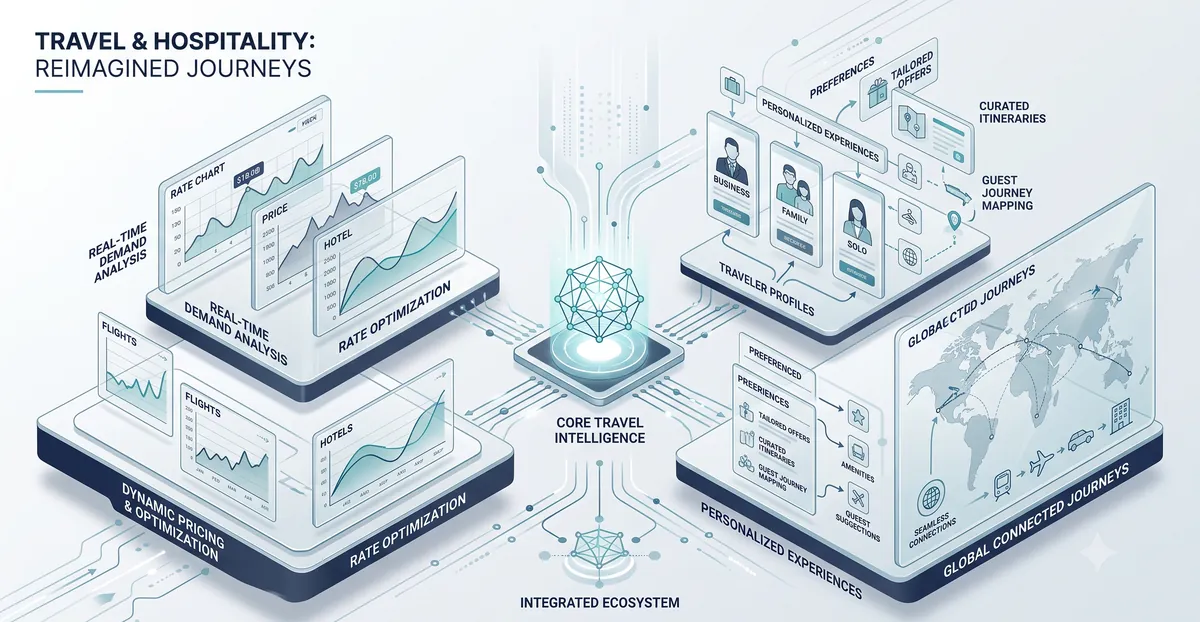
The Context Shaping Travel & Hospitality
Understanding the macro trends and digital priorities driving the need for AI transformation in your sector.
Industry Trends
- Shift towards highly personalized, hyper-local travel experiences
- Rise of contactless technology and self-service kiosks
- Increasing focus on sustainable and eco-friendly travel options
- Blurring lines between business and leisure travel (Bleisure)
Digital Priorities
- Creating seamless omnichannel booking journeys
- Leveraging customer data platforms (CDP) for personalization
- Automating guest services with conversational AI
- Modernizing legacy property management systems (PMS)
AI Maturity
The travel and hospitality sector is highly data-driven but fragmented. AI maturity is strong in airline revenue management and OTA recommendations, while hotels are rapidly adopting AI for hyper-personalization and automated guest services.
The Challenges Shaping the Future of Travel & Hospitality
Strategic barriers preventing organizations from scaling effectively, which AI is uniquely positioned to solve.
Volatile Demand
Managing unpredictable fluctuations in travel demand driven by economic or global events.
Labor Shortages
Struggling to staff front-line roles in hotels and airports.
High Customer Expectations
Meeting the demand for personalized, instantaneous service at every touchpoint.
Legacy Infrastructure
Integrating modern AI tools with antiquated booking and property management systems.
Where AI Creates the Greatest Business Impact
How enterprise AI capabilities directly address your core challenges to unlock new value and operational efficiency.
Hyper-Personalization
Tailoring recommendations, room settings, and offers to individual guest preferences.
Revenue Maximization
Optimizing pricing in real-time based on granular demand forecasting.
Contactless Service
Enhancing the guest experience with AI-powered mobile check-ins and concierges.
Operational Automation
Streamlining housekeeping, maintenance, and back-office operations.
High-Value AI Use Cases Across the Travel & Hospitality Value Chain
Proven applications driving measurable business value, efficiency, and transformation in Travel & Hospitality.
1Dynamic Pricing and Revenue Management
The Problem
Static or rules-based pricing fails to capture maximum value during demand surges or fill rooms during lulls.
The Outcome
Increases RevPAR (Revenue Per Available Room) by 5-15%.
Example Workflow
AI models analyze real-time market data, competitor pricing, weather, and local events to continuously adjust room rates multiple times a day.
2Hyper-Personalized Travel Recommendations
The Problem
Generic travel packages result in low conversion rates and poor customer engagement.
The Outcome
Boosts booking conversion rates by 20% and increases ancillary revenue.
Example Workflow
Machine learning algorithms analyze a user's browsing history, past bookings, and social media sentiment to curate bespoke itineraries and hotel recommendations.
3Conversational AI Concierge
The Problem
Front desk staff are overwhelmed by routine guest inquiries, leading to long wait times and frustration.
The Outcome
Automates 60% of routine guest requests and improves guest satisfaction scores.
Example Workflow
Multilingual chatbots and voice assistants integrated into hotel apps or smart room devices instantly handle requests for extra towels, room service, or local restaurant recommendations.
4Predictive Maintenance for Hotel Operations
The Problem
Unexpected HVAC or elevator failures ruin the guest experience and incur costly emergency repairs.
The Outcome
Reduces equipment downtime by 30% and lowers maintenance costs.
Example Workflow
IoT sensors on critical equipment feed data to AI models that predict failures and automatically generate work orders for maintenance staff before a breakdown occurs.
5Sentiment Analysis for Guest Feedback
The Problem
Manually analyzing thousands of online reviews and survey responses is slow and misses critical operational insights.
The Outcome
Provides real-time actionable insights to property managers to fix recurring issues.
Example Workflow
NLP algorithms automatically categorize and analyze sentiment from TripAdvisor reviews and post-stay surveys, alerting management to specific problems like 'noisy air conditioning' in certain wings.
6Housekeeping Optimization
The Problem
Static housekeeping schedules are inefficient, leading to delayed check-ins when rooms aren't ready.
The Outcome
Increases housekeeping efficiency by 15% and guarantees faster room turnover.
Example Workflow
AI optimizes housekeeping routes dynamically based on real-time checkout data, VIP status, and room cleaning complexity.
7Fraud Detection in Bookings and Loyalty Programs
The Problem
Account takeovers and payment fraud cost the industry billions and damage brand reputation.
The Outcome
Reduces chargebacks and loyalty point theft by over 40%.
Example Workflow
Anomaly detection models analyze booking patterns, IP addresses, and behavioral biometrics to flag and block fraudulent transactions in milliseconds.
8Smart Room Energy Management
The Problem
Empty hotel rooms consume significant energy for heating and cooling, driving up operational costs and carbon footprints.
The Outcome
Reduces room energy consumption by 20-30%.
Example Workflow
AI integrates with occupancy sensors and weather forecasts to automatically adjust thermostats and lighting when guests leave the room, pre-conditioning them before they return.
9Food Waste Reduction in Buffets
The Problem
Hotels and cruise lines waste massive amounts of food due to inaccurate forecasting of guest consumption.
The Outcome
Cuts food waste by 30% and significantly lowers food procurement costs.
Example Workflow
Computer vision systems monitor buffet pans to track exactly what is consumed, while AI models forecast daily production needs based on occupancy and guest demographics.
10Next-Best-Action for Call Center Agents
The Problem
Call center agents struggle to navigate complex booking systems to offer relevant upsells or resolve complaints quickly.
The Outcome
Decreases average handle time (AHT) by 15% and increases upsell conversion.
Example Workflow
AI analyzes the live conversation and guest profile to prompt the agent with the optimal resolution or personalized upgrade offer on their screen.
11Automated Baggage Handling
The Problem
Mishandled baggage is a major source of customer dissatisfaction and compensation costs for airlines.
The Outcome
Reduces mishandled baggage rates by up to 25%.
Example Workflow
Computer vision scans baggage tags and physical bag characteristics to accurately route luggage through complex airport sorting systems, predicting bottlenecks.
12Crew Rostering Optimization
The Problem
Scheduling flight or cruise crews while adhering to strict union rules and fatigue regulations is incredibly complex.
The Outcome
Reduces crew costs by 5% and improves schedule robustness against disruptions.
Example Workflow
Advanced optimization algorithms generate efficient rosters that maximize crew utilization while strictly adhering to regulatory constraints and individual preferences.
Risk & Governance
Building Responsible and Trusted AI
Governance in travel and hospitality heavily emphasizes data privacy, as companies collect vast amounts of PII and payment data. AI must also be deployed fairly, avoiding algorithmic bias in dynamic pricing models. Synottic's Responsible AI frameworks ensure that your deployments meet critical standards for security, privacy, and fairness.
GDPR and CCPA for global consumer data privacy
PCI DSS for securing payment transactions
ADA (Americans with Disabilities Act) compliance for AI-driven digital interfaces
How Synottic Helps
- 1
AI Readiness Audit
We assess your data infrastructure and governance posture against Travel & Hospitality regulatory standards.
- 2
Guardrails Implementation
Deploy enterprise guardrails to prevent data leakage, bias, and hallucination.
- 3
Continuous Monitoring
Automated drift detection and bias auditing for production models to ensure ongoing compliance.
Your Recommended AI Capability Journey
A structured capability-building roadmap tailored for Travel & Hospitality professionals, from foundational literacy to enterprise-scale AI implementation.
1
Phase 1
Build Foundations
Understand AI terminology, concepts, and responsible use cases specific to Travel Hospitality.
AI Literacy Essentials
1 - 3 Days
Skills Acquired
- Explain core AI concepts in simple business language
- Distinguish AI assistants, copilots, automation and agents
- Write effective prompts using structured frameworks
View Program
Generative AI Essentials
1 - 3 Days
Skills Acquired
- Explain Generative AI in practical business terms
- Understand LLMs and foundation models conceptually
- Select an appropriate AI tool for a given task
View Program
2
Phase 2
Develop Practical Skills
Master generative AI tools to improve daily productivity and communication in Travel Hospitality.
3
Phase 3
Apply AI
Apply AI to function-specific workflows, operations, and strategic planning within Travel Hospitality.
AI for Operations & Supply Chain
1 - 3 Days
Skills Acquired
- Understand AI concepts and practical applications in operations
- Use AI assistants to automate operational activities
- Improve demand forecasting and inventory planning
View Program
AI for Marketing
1 - 3 Days
Skills Acquired
- Understand AI applications across marketing functions
- Use AI assistants to improve daily marketing productivity
- Create effective prompts for content and campaigns
View Program
AI for Customer Service
1 - 3 Days
Skills Acquired
- Apply AI confidently across the customer service lifecycle
- Deliver faster, more personalized customer support
- Reduce response and resolution times using AI assistants
View Program
4
Phase 4
Govern & Scale
Deploy and govern secure, agentic AI systems that comply with Travel Hospitality regulations.
Responsible AI Essentials
1 - 3 Days
Skills Acquired
- Apply Responsible AI principles in everyday work
- Identify and mitigate AI risks
- Evaluate AI systems for fairness and transparency
View Program
AI Agents Essentials
1 - 3 Days
Skills Acquired
- Understand enterprise Agentic AI architectures
- Design AI agent workflows
- Connect AI agents to enterprise systems
View Program
5
Phase 5
Enterprise Capability
Scale AI adoption and build internal capability across your entire Travel Hospitality organization.
The Synottic Transformation Journey
A structured pathway from discovery through to continuous business value, ensuring lasting impact.
1
Discovery
2
Strategize
3
Enable
4
Govern
5
Deploy
6
Scale
How Synottic Helps You Succeed
End-to-end consulting and implementation services designed specifically for Travel & Hospitality.
AI Readiness Assessment
Measure organisational AI maturity and identify strategic capability gaps.
AI Strategy
Align AI initiatives with business goals and operational priorities to maximize ROI.
Executive Advisory
Support senior leaders with AI strategy and long-term transformation planning.
Capability Building
Train your workforce with tailored, role-based AI enablement programs.
Responsible AI & Governance
Establish policies, controls, and ethical frameworks to mitigate AI risks.
Agentic AI & Implementation
Design and deploy autonomous AI agents for complex enterprise processes.
Frequently Asked Questions
AI enables dynamic pricing, meaning room rates adjust automatically based on real-time demand, competitor prices, and market conditions. This ensures hotels maximize revenue while offering competitive rates to consumers.