Loading…
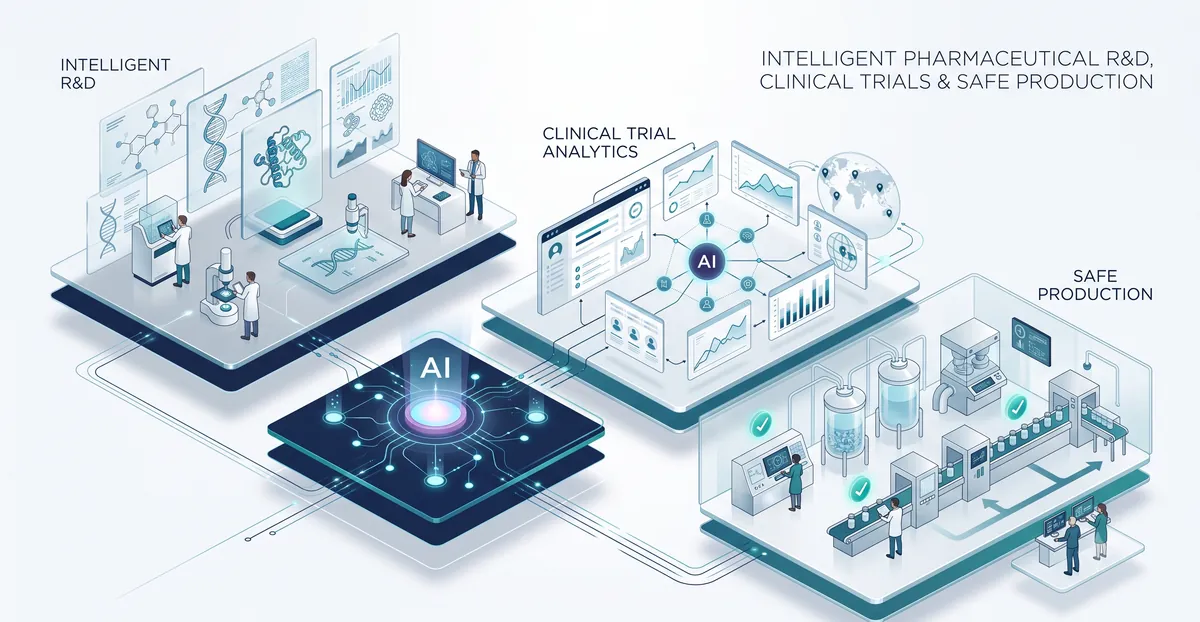
The Context Shaping Pharmaceuticals
Understanding the macro trends and digital priorities driving the need for AI transformation in your sector.
Industry Trends
- Accelerated timeline from discovery to clinic
- Shift towards precision and personalized medicine
- Decentralized and in-silico clinical trials
- Integration of real-world evidence (RWE)
Digital Priorities
- Scale computational biology and chemistry
- Automate regulatory document authoring
- Optimize commercial operations and field forces
- Ensure robust digital supply chain traceability
AI Maturity
Pharma is aggressively adopting AI across the value chain. Generative AI is transforming molecular design and protein folding, while predictive analytics is reshaping how clinical trials are designed and executed.
The Challenges Shaping the Future of Pharmaceuticals
Strategic barriers preventing organizations from scaling effectively, which AI is uniquely positioned to solve.
High R&D Costs
Bringing a new drug to market costs billions and takes over a decade.
Clinical Trial Delays
Difficulty in recruiting and retaining suitable patients delays time-to-market.
Regulatory Complexity
Navigating FDA/EMA submissions requires immense manual document preparation.
Supply Chain Disruptions
Cold chain logistics and API sourcing are highly vulnerable to global shocks.
Where AI Creates the Greatest Business Impact
How enterprise AI capabilities directly address your core challenges to unlock new value and operational efficiency.
Generative Drug Design
Inventing novel molecular structures optimized for target binding.
Automated Regulatory Submissions
Drafting clinical study reports (CSRs) using GenAI.
Smart Manufacturing
Predictive maintenance and quality control in batch processing.
Commercial Intelligence
Optimizing engagement with Healthcare Professionals (HCPs).
High-Value AI Use Cases Across the Pharmaceuticals Value Chain
Proven applications driving measurable business value, efficiency, and transformation in Pharmaceuticals.
1De Novo Drug Design
The Problem
Traditional high-throughput screening is slow and explores only a fraction of chemical space.
The Outcome
Reduction in discovery timelines from years to months.
Example Workflow
Generative adversarial networks (GANs) propose novel molecules with desired properties (solubility, toxicity) for synthesis.
2Clinical Trial Patient Matching
The Problem
Finding eligible patients with specific genetic profiles across disparate sites causes massive delays.
The Outcome
30% faster trial recruitment and increased protocol adherence.
Example Workflow
NLP engines mine unstructured EHR data across hospital networks to identify perfect candidates for oncology trials.
3Target Identification and Validation
The Problem
Identifying the right biological target for a disease is prone to high failure rates.
The Outcome
Higher probability of success in Phase 1 and 2 trials.
Example Workflow
Knowledge graphs and AI algorithms analyze multi-omics data and scientific literature to uncover hidden disease pathways.
4Automated Clinical Study Reports (CSR)
The Problem
Medical writers spend months aggregating data to write regulatory submissions.
The Outcome
50% reduction in submission drafting time.
Example Workflow
GenAI drafts initial versions of complex regulatory documents by synthesizing data tables and clinical narratives.
5Real-World Evidence (RWE) Analytics
The Problem
Understanding post-market drug efficacy and safety signals is complex and data-heavy.
The Outcome
Faster identification of adverse events and new label expansion opportunities.
Example Workflow
Machine learning analyzes claims data and social media to monitor post-launch safety profiles and efficacy.
6Predictive Quality Assurance in Manufacturing
The Problem
Batch failures in biologics manufacturing cost millions and cause drug shortages.
The Outcome
20% increase in yield and reduction in discarded batches.
Example Workflow
AI monitors bioreactor sensors in real-time, predicting and correcting parameter drifts before they impact product quality.
7Next-Best-Action for Field Sales
The Problem
Pharmaceutical reps struggle to deliver tailored, relevant information to busy physicians.
The Outcome
Increased HCP engagement and optimized sales territory planning.
Example Workflow
Recommendation engines advise reps on the best channel, time, and content (e.g., clinical reprint vs. webinar) to engage specific doctors.
8Cold Chain Logistics Optimization
The Problem
Temperature-sensitive drugs (like vaccines) spoil if cold chain breaks occur during transit.
The Outcome
Significant reduction in product spoilage.
Example Workflow
Predictive algorithms analyze weather, traffic, and IoT sensor data to reroute shipments and proactively address temperature excursions.
9Protein Structure Prediction
The Problem
Determining 3D protein structures via X-ray crystallography takes months to years.
The Outcome
Instantaneous structural models to accelerate rational drug design.
Example Workflow
Deep learning models (like AlphaFold variants) predict protein folding and binding pockets for new therapeutic targets.
10Pharmacovigilance Automation
The Problem
Manual intake and processing of adverse event reports is unscalable and prone to human error.
The Outcome
Faster compliance reporting and reduced manual triage effort.
Example Workflow
NLP extracts symptoms, patient demographics, and drug interactions from unstructured adverse event reports for immediate regulatory filing.
11Digital Biomarker Discovery
The Problem
Objective measurement of disease progression (e.g., Parkinson's) is difficult in traditional clinical settings.
The Outcome
More sensitive trial endpoints and continuous patient monitoring.
Example Workflow
AI analyzes voice patterns or smartwatch accelerometer data to detect minute changes in neurological function.
12Supply Chain Demand Forecasting
The Problem
Volatile demand and long manufacturing lead times result in stockouts or massive overstock.
The Outcome
Optimized inventory levels and ensured drug availability.
Example Workflow
Machine learning predicts local drug demand by analyzing epidemiological trends, competitor out-of-stocks, and seasonality.
Risk & Governance
Building Responsible and Trusted AI
Pharma AI requires Good Machine Learning Practice (GMLP) and validation to ensure algorithms do not compromise patient safety or data integrity. GxP compliance is mandatory. Synottic's Responsible AI frameworks ensure that your deployments meet critical standards for security, privacy, and fairness.
FDA 21 CFR Part 11
EMA AI guidelines
GxP (GMP, GCP, GLP)
ISO 13485
How Synottic Helps
- 1
AI Readiness Audit
We assess your data infrastructure and governance posture against Pharmaceuticals regulatory standards.
- 2
Guardrails Implementation
Deploy enterprise guardrails to prevent data leakage, bias, and hallucination.
- 3
Continuous Monitoring
Automated drift detection and bias auditing for production models to ensure ongoing compliance.
Your Recommended AI Capability Journey
A structured capability-building roadmap tailored for Pharmaceuticals professionals, from foundational literacy to enterprise-scale AI implementation.
1
Phase 1
Build Foundations
Understand AI terminology, concepts, and responsible use cases specific to Pharmaceuticals.
AI Literacy Essentials
1 - 3 Days
Skills Acquired
- Explain core AI concepts in simple business language
- Distinguish AI assistants, copilots, automation and agents
- Write effective prompts using structured frameworks
View Program
Generative AI Essentials
1 - 3 Days
Skills Acquired
- Explain Generative AI in practical business terms
- Understand LLMs and foundation models conceptually
- Select an appropriate AI tool for a given task
View Program
2
Phase 2
Develop Practical Skills
Master generative AI tools to improve daily productivity and communication in Pharmaceuticals.
3
Phase 3
Apply AI
Apply AI to function-specific workflows, operations, and strategic planning within Pharmaceuticals.
AI for Operations & Supply Chain
1 - 3 Days
Skills Acquired
- Understand AI concepts and practical applications in operations
- Use AI assistants to automate operational activities
- Improve demand forecasting and inventory planning
View Program
AI for Marketing
1 - 3 Days
Skills Acquired
- Understand AI applications across marketing functions
- Use AI assistants to improve daily marketing productivity
- Create effective prompts for content and campaigns
View Program
AI for Customer Service
1 - 3 Days
Skills Acquired
- Apply AI confidently across the customer service lifecycle
- Deliver faster, more personalized customer support
- Reduce response and resolution times using AI assistants
View Program
4
Phase 4
Govern & Scale
Deploy and govern secure, agentic AI systems that comply with Pharmaceuticals regulations.
5
Phase 5
Enterprise Capability
Scale AI adoption and build internal capability across your entire Pharmaceuticals organization.
The Synottic Transformation Journey
A structured pathway from discovery through to continuous business value, ensuring lasting impact.
1
Discovery
2
Strategize
3
Enable
4
Govern
5
Deploy
6
Scale
How Synottic Helps You Succeed
End-to-end consulting and implementation services designed specifically for Pharmaceuticals.
AI Readiness Assessment
Measure organisational AI maturity and identify strategic capability gaps.
AI Strategy
Align AI initiatives with business goals and operational priorities to maximize ROI.
Executive Advisory
Support senior leaders with AI strategy and long-term transformation planning.
Capability Building
Train your workforce with tailored, role-based AI enablement programs.
Responsible AI & Governance
Establish policies, controls, and ethical frameworks to mitigate AI risks.
Agentic AI & Implementation
Design and deploy autonomous AI agents for complex enterprise processes.
Frequently Asked Questions
No, AI is a powerful tool that accelerates the discovery phase, but human scientists are required for synthesis, validation, and clinical testing.