Loading…
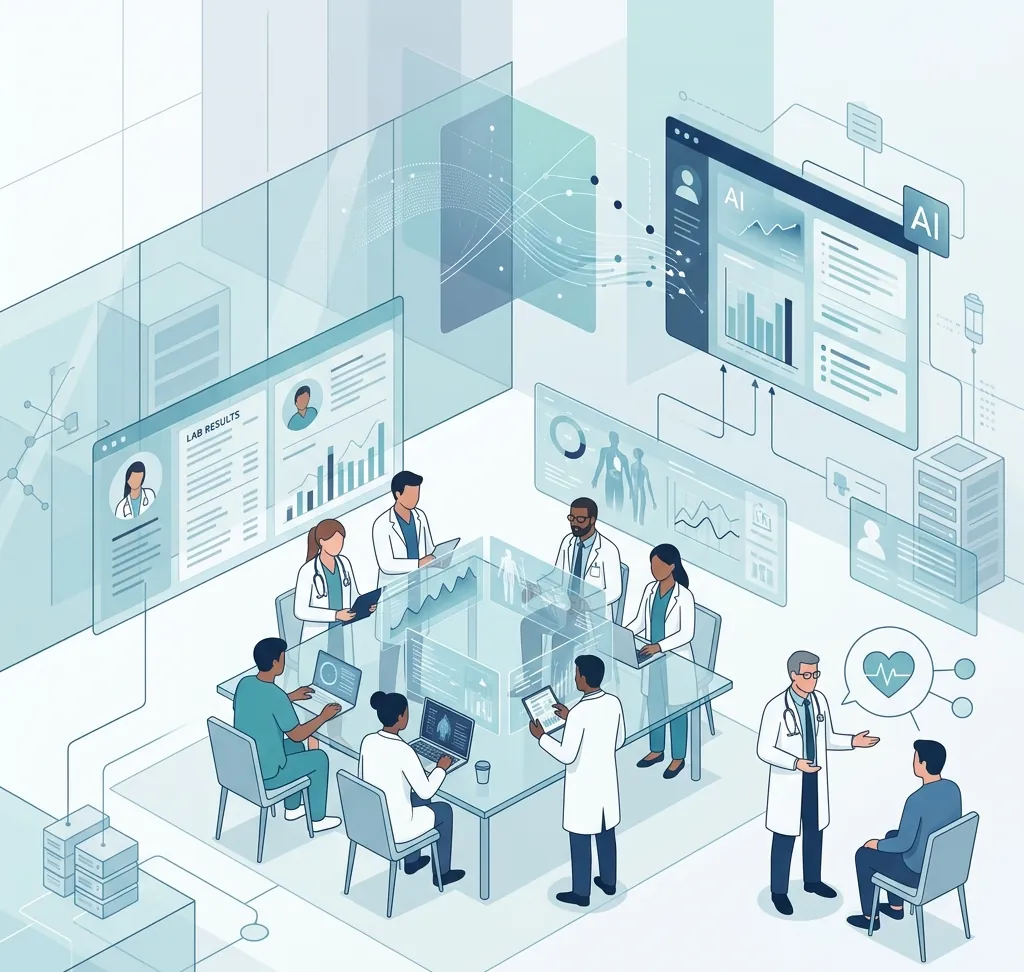
The Context Shaping Healthcare
Understanding the macro trends and digital priorities driving the need for AI transformation in your sector.
Industry Trends
- Transition to value-based care models
- Expansion of virtual wards and remote patient monitoring
- Ambient clinical intelligence to reduce burnout
- Interoperability of Electronic Health Records (EHR)
Digital Priorities
- Alleviate clinician burnout through automation
- Improve diagnostic accuracy with multimodal AI
- Optimize hospital operations and resource allocation
- Enhance data privacy and cybersecurity posture
AI Maturity
Healthcare is at an inflection point. While predictive analytics have been used for population health, GenAI and computer vision are now revolutionizing direct clinical workflows, medical imaging, and administrative operations.
The Challenges Shaping the Future of Healthcare
Strategic barriers preventing organizations from scaling effectively, which AI is uniquely positioned to solve.
Clinician Burnout
Administrative burdens and 'pajama time' EHR documentation are driving staff shortages.
Data Privacy & Compliance
Strict HIPAA regulations make data sharing and model training highly complex.
Fragmented Patient Data
Lack of interoperability between different EHR systems creates blind spots in patient history.
High Operational Costs
Inefficiencies in billing, scheduling, and supply chain erode operating margins.
Where AI Creates the Greatest Business Impact
How enterprise AI capabilities directly address your core challenges to unlock new value and operational efficiency.
Ambient Clinical Documentation
Automating clinical notes to give doctors back time with patients.
Precision Diagnostics
Assisting radiologists and pathologists with AI-driven image analysis.
Predictive Patient Flow
Forecasting ER admissions to optimize staffing and bed management.
Automated Billing & Coding
Reducing claim denials through intelligent revenue cycle management.
High-Value AI Use Cases Across the Healthcare Value Chain
Proven applications driving measurable business value, efficiency, and transformation in Healthcare.
1Ambient Clinical Voice Scribing
The Problem
Physicians spend excessive time on EHR documentation, detracting from patient care.
The Outcome
Saves up to 2 hours per day per physician, reducing burnout.
Example Workflow
Ambient AI listens to patient-doctor conversations and automatically generates structured SOAP notes in the EHR.
2Medical Imaging Analysis (Radiology AI)
The Problem
High volume of medical scans leads to radiologist fatigue and delayed diagnoses.
The Outcome
20% faster turnaround times and reduced missed anomalies.
Example Workflow
Computer vision algorithms highlight potential tumors, fractures, or bleeds on X-rays and MRIs for priority review.
3Sepsis Early Warning System
The Problem
Sepsis is a leading cause of hospital mortality, and every hour of delayed treatment decreases survival.
The Outcome
15% reduction in sepsis-related mortality.
Example Workflow
Predictive models continuously monitor vital signs and lab results to alert nurses hours before clinical symptoms appear.
4Intelligent Revenue Cycle Management (RCM)
The Problem
Complex coding rules and errors lead to high rates of insurance claim denials.
The Outcome
30% reduction in claim denials and accelerated cash flow.
Example Workflow
AI analyzes clinical notes to suggest accurate ICD-10 codes and predicts which claims are likely to be denied before submission.
5Predictive Hospital Bed Management
The Problem
Unpredictable patient admissions cause ER overcrowding and inefficient staffing.
The Outcome
Optimized bed utilization and reduced patient wait times.
Example Workflow
Machine learning forecasts daily admission rates based on historical data, seasonality, and local health trends.
6Virtual Patient Triage & Navigation
The Problem
Patients struggle to know when and where to seek care, leading to unnecessary ER visits.
The Outcome
25% reduction in low-acuity ER visits.
Example Workflow
GenAI chatbots assess patient symptoms and direct them to the appropriate care setting (e.g., urgent care, telehealth).
7Operating Room (OR) Scheduling Optimization
The Problem
ORs are the most expensive resource in a hospital; scheduling gaps waste millions.
The Outcome
10% increase in OR utilization rates.
Example Workflow
AI predicts precise surgery durations based on the specific surgeon, procedure, and patient profile to tighten schedules.
8Remote Patient Monitoring Analytics
The Problem
Data from wearables and home medical devices overwhelms care teams without actionable insights.
The Outcome
Decreased readmission rates for chronic disease patients.
Example Workflow
Algorithms filter continuous streams of patient data, flagging only significant deviations for clinical intervention.
9Patient Deterioration Prediction
The Problem
Patients on general wards can deteriorate rapidly without continuous intensive monitoring.
The Outcome
Reduction in code blue events and unplanned ICU transfers.
Example Workflow
Risk scoring models aggregate EHR data to identify ward patients at high risk of rapid decline.
10AI-Assisted Pathology
The Problem
Manual review of tissue slides is time-consuming and prone to subjective interpretation.
The Outcome
Increased diagnostic consensus and faster cancer staging.
Example Workflow
Deep learning models grade prostate or breast cancer biopsies, highlighting regions of interest for the pathologist.
11Personalized Treatment Pathways
The Problem
Standard treatment protocols don't account for individual genetic or lifestyle factors.
The Outcome
Improved therapeutic outcomes and reduced adverse drug events.
Example Workflow
AI analyzes a patient's pharmacogenomics and medical history to recommend the most effective medication dosage.
12Supply Chain & Inventory Management
The Problem
Stockouts of critical medical supplies or expiration of expensive drugs disrupt care.
The Outcome
20% reduction in inventory holding costs and waste.
Example Workflow
Predictive analytics forecast demand for PPE, surgical supplies, and medications based on upcoming procedures.
Risk & Governance
Building Responsible and Trusted AI
Healthcare AI requires the highest levels of governance to ensure patient safety and data privacy. Bias in clinical algorithms can lead to disparate health outcomes, necessitating continuous validation. Synottic's Responsible AI frameworks ensure that your deployments meet critical standards for security, privacy, and fairness.
HIPAA
FDA Software as a Medical Device (SaMD)
HITECH Act
GDPR
How Synottic Helps
- 1
AI Readiness Audit
We assess your data infrastructure and governance posture against Healthcare regulatory standards.
- 2
Guardrails Implementation
Deploy enterprise guardrails to prevent data leakage, bias, and hallucination.
- 3
Continuous Monitoring
Automated drift detection and bias auditing for production models to ensure ongoing compliance.
Your Recommended AI Capability Journey
A structured capability-building roadmap tailored for Healthcare professionals, from foundational literacy to enterprise-scale AI implementation.
1
Phase 1
Build Foundations
Understand AI terminology, concepts, and responsible use cases specific to Healthcare.
AI Literacy Essentials
1 - 3 Days
Skills Acquired
- Explain core AI concepts in simple business language
- Distinguish AI assistants, copilots, automation and agents
- Write effective prompts using structured frameworks
View Program
Generative AI Essentials
1 - 3 Days
Skills Acquired
- Explain Generative AI in practical business terms
- Understand LLMs and foundation models conceptually
- Select an appropriate AI tool for a given task
View Program
2
Phase 2
Develop Practical Skills
Master generative AI tools to improve daily productivity and communication in Healthcare.
3
Phase 3
Apply AI
Apply AI to function-specific workflows, operations, and strategic planning within Healthcare.
AI for Operations & Supply Chain
1 - 3 Days
Skills Acquired
- Understand AI concepts and practical applications in operations
- Use AI assistants to automate operational activities
- Improve demand forecasting and inventory planning
View Program
AI for Marketing
1 - 3 Days
Skills Acquired
- Understand AI applications across marketing functions
- Use AI assistants to improve daily marketing productivity
- Create effective prompts for content and campaigns
View Program
AI for Customer Service
1 - 3 Days
Skills Acquired
- Apply AI confidently across the customer service lifecycle
- Deliver faster, more personalized customer support
- Reduce response and resolution times using AI assistants
View Program
4
Phase 4
Govern & Scale
Deploy and govern secure, agentic AI systems that comply with Healthcare regulations.
5
Phase 5
Enterprise Capability
Scale AI adoption and build internal capability across your entire Healthcare organization.
The Synottic Transformation Journey
A structured pathway from discovery through to continuous business value, ensuring lasting impact.
1
Discovery
2
Strategize
3
Enable
4
Govern
5
Deploy
6
Scale
How Synottic Helps You Succeed
End-to-end consulting and implementation services designed specifically for Healthcare.
AI Readiness Assessment
Measure organisational AI maturity and identify strategic capability gaps.
AI Strategy
Align AI initiatives with business goals and operational priorities to maximize ROI.
Executive Advisory
Support senior leaders with AI strategy and long-term transformation planning.
Capability Building
Train your workforce with tailored, role-based AI enablement programs.
Responsible AI & Governance
Establish policies, controls, and ethical frameworks to mitigate AI risks.
Agentic AI & Implementation
Design and deploy autonomous AI agents for complex enterprise processes.
Frequently Asked Questions
No. AI is designed to augment clinical decision-making and automate administrative tasks, allowing doctors to focus on the human elements of patient care.