Loading…
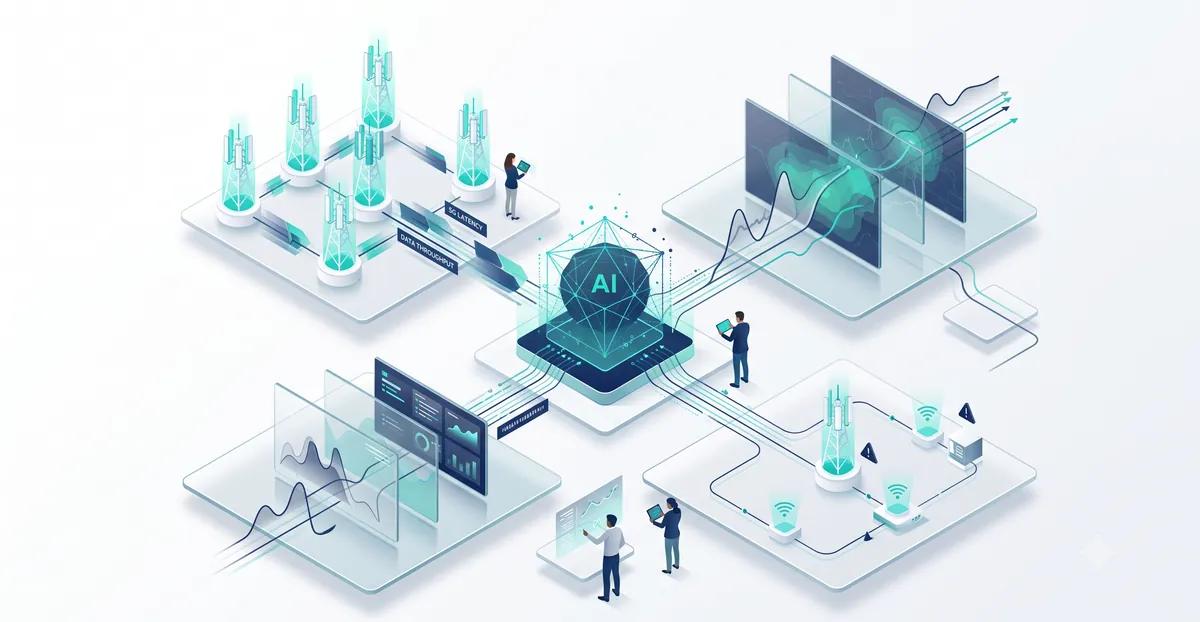
The Context Shaping Telecommunications
Understanding the macro trends and digital priorities driving the need for AI transformation in your sector.
Industry Trends
- AI-driven autonomous networks (Zero-touch networks)
- Monetization of 5G through edge computing
- Hyper-personalization in customer service
- Integration of generative AI in BSS/OSS systems
Digital Priorities
- Migrating legacy OSS/BSS to cloud-native platforms
- Implementing AI for network slicing
- Enhancing self-service channels with conversational AI
- Data monetization through advanced analytics
AI Maturity
The telecom sector has high AI maturity, particularly in network operations and customer service. Large telcos are heavily investing in AI to manage the complexity of 5G networks and reduce high customer churn rates.
The Challenges Shaping the Future of Telecommunications
Strategic barriers preventing organizations from scaling effectively, which AI is uniquely positioned to solve.
Network Complexity
Managing the exponential growth in data traffic and the complexity of 5G and IoT networks.
High Customer Churn
Fierce competition and commoditization of services lead to high customer turnover.
Legacy Infrastructure
Technical debt from outdated legacy systems hinders agility and data integration.
Fraud and Security Risks
Increasingly sophisticated fraud schemes (e.g., SIM swapping, toll fraud) cost billions annually.
Where AI Creates the Greatest Business Impact
How enterprise AI capabilities directly address your core challenges to unlock new value and operational efficiency.
Autonomous Networks
Self-healing networks that automatically detect, diagnose, and resolve issues without human intervention.
Proactive Customer Care
Predicting customer issues (e.g., billing shock, poor coverage) before they happen and reaching out proactively.
Edge AI Monetization
Offering low-latency AI computing capabilities at the edge for enterprise customers.
Dynamic Pricing
Offering personalized data plans and services based on real-time usage patterns.
High-Value AI Use Cases Across the Telecommunications Value Chain
Proven applications driving measurable business value, efficiency, and transformation in Telecommunications.
1Predictive Network Maintenance
The Problem
Network outages lead to severe customer dissatisfaction and financial penalties.
The Outcome
20-30% reduction in network downtime and optimized field technician dispatch.
Example Workflow
AI analyzes telemetry data from cell towers to predict hardware failures days before they occur.
2Customer Churn Prediction
The Problem
Acquiring a new customer is significantly more expensive than retaining an existing one.
The Outcome
Reduction of churn rates by 10-15% through targeted retention campaigns.
Example Workflow
Machine learning models analyze usage drops, billing complaints, and competitor pricing to flag high-risk customers.
3Conversational AI for Customer Support
The Problem
High volume of routine calls (billing, plan changes) overwhelms call centers.
The Outcome
Deflection of up to 50% of routine calls, drastically reducing support costs.
Example Workflow
Generative AI virtual assistants handle complex customer queries via voice and text with natural language understanding.
4Network Slicing Optimization
The Problem
Manually configuring network slices for different enterprise needs (e.g., IoT vs. high-bandwidth video) is inefficient.
The Outcome
Dynamic allocation of network resources, maximizing ROI on 5G infrastructure.
Example Workflow
AI dynamically allocates bandwidth and latency parameters to specific network slices based on real-time demand.
5Fraud Detection & Prevention
The Problem
Telecom fraud (e.g., subscription fraud, SIM cloning) causes massive revenue leakage.
The Outcome
Detection and blocking of fraudulent activity in real-time, saving millions.
Example Workflow
Anomaly detection algorithms analyze call detail records (CDRs) and behavioral patterns to instantly flag suspicious activity.
6Next-Best-Action for Sales
The Problem
Customer service agents lack real-time insights into the best products to cross-sell or up-sell.
The Outcome
20% increase in cross-sell conversion rates.
Example Workflow
AI recommends the most relevant product or upgrade to an agent during a customer interaction based on the customer's profile.
7Field Service Optimization
The Problem
Inefficient routing of field technicians leads to high fuel costs and delayed repairs.
The Outcome
Improved SLA compliance and a 15% reduction in travel time for technicians.
Example Workflow
AI algorithms optimize dispatch schedules and routes in real-time based on traffic, technician skills, and job priority.
8Capacity Planning
The Problem
Over-provisioning network capacity wastes capital, while under-provisioning degrades service.
The Outcome
Optimized CAPEX spending and improved network performance during peak times.
Example Workflow
Predictive models forecast network traffic growth at a granular geographical level to guide infrastructure investments.
9Automated Document Processing
The Problem
Manual processing of contracts, invoices, and compliance documents is slow and error-prone.
The Outcome
Faster processing times and reduced administrative overhead.
Example Workflow
OCR and NLP extract key data from enterprise contracts to automatically update billing systems.
10Smart Capital Expenditure (CAPEX) Allocation
The Problem
Deciding where to deploy new cell towers or fiber optics relies heavily on intuition rather than data.
The Outcome
Maximized return on infrastructure investments.
Example Workflow
AI evaluates demographic data, current network congestion, and competitor presence to recommend the most profitable locations for expansion.
11Personalized Marketing & Offers
The Problem
Generic mass marketing yields low conversion rates.
The Outcome
Higher ARPU (Average Revenue Per User) and improved campaign ROI.
Example Workflow
Generative AI creates personalized marketing copy and custom data bundle offers for specific micro-segments.
12Robotic Process Automation (RPA) in BSS
The Problem
Legacy Business Support Systems require extensive manual data entry to process orders and billing.
The Outcome
Reduction of manual processing errors by 90% and faster order-to-cash cycles.
Example Workflow
AI-enhanced RPA bots automatically execute data transfers between legacy billing and modern CRM systems.
Risk & Governance
Building Responsible and Trusted AI
Telecommunications companies handle vast amounts of sensitive customer data, including location data and communication logs. AI governance must focus heavily on data privacy, secure data sharing, and compliance with stringent telecommunications regulations. Synottic's Responsible AI frameworks ensure that your deployments meet critical standards for security, privacy, and fairness.
GDPR & CCPA
Telecommunications Act Compliance
ISO/IEC 27001 (Information Security)
CALEA (Communications Assistance for Law Enforcement Act)
How Synottic Helps
- 1
AI Readiness Audit
We assess your data infrastructure and governance posture against Telecommunications regulatory standards.
- 2
Guardrails Implementation
Deploy enterprise guardrails to prevent data leakage, bias, and hallucination.
- 3
Continuous Monitoring
Automated drift detection and bias auditing for production models to ensure ongoing compliance.
Your Recommended AI Capability Journey
A structured capability-building roadmap tailored for Telecommunications professionals, from foundational literacy to enterprise-scale AI implementation.
1
Phase 1
Build Foundations
Understand AI terminology, concepts, and responsible use cases specific to Telecommunications.
AI Literacy Essentials
1 - 3 Days
Skills Acquired
- Explain core AI concepts in simple business language
- Distinguish AI assistants, copilots, automation and agents
- Write effective prompts using structured frameworks
View Program
Generative AI Essentials
1 - 3 Days
Skills Acquired
- Explain Generative AI in practical business terms
- Understand LLMs and foundation models conceptually
- Select an appropriate AI tool for a given task
View Program
2
Phase 2
Develop Practical Skills
Master generative AI tools to improve daily productivity and communication in Telecommunications.
3
Phase 3
Apply AI
Apply AI to function-specific workflows, operations, and strategic planning within Telecommunications.
AI for Operations & Supply Chain
1 - 3 Days
Skills Acquired
- Understand AI concepts and practical applications in operations
- Use AI assistants to automate operational activities
- Improve demand forecasting and inventory planning
View Program
AI for Marketing
1 - 3 Days
Skills Acquired
- Understand AI applications across marketing functions
- Use AI assistants to improve daily marketing productivity
- Create effective prompts for content and campaigns
View Program
AI for Customer Service
1 - 3 Days
Skills Acquired
- Apply AI confidently across the customer service lifecycle
- Deliver faster, more personalized customer support
- Reduce response and resolution times using AI assistants
View Program
4
Phase 4
Govern & Scale
Deploy and govern secure, agentic AI systems that comply with Telecommunications regulations.
Responsible AI Essentials
1 - 3 Days
Skills Acquired
- Apply Responsible AI principles in everyday work
- Identify and mitigate AI risks
- Evaluate AI systems for fairness and transparency
View Program
AI Agents Essentials
1 - 3 Days
Skills Acquired
- Understand enterprise Agentic AI architectures
- Design AI agent workflows
- Connect AI agents to enterprise systems
View Program
5
Phase 5
Enterprise Capability
Scale AI adoption and build internal capability across your entire Telecommunications organization.
The Synottic Transformation Journey
A structured pathway from discovery through to continuous business value, ensuring lasting impact.
1
Discovery
2
Strategize
3
Enable
4
Govern
5
Deploy
6
Scale
How Synottic Helps You Succeed
End-to-end consulting and implementation services designed specifically for Telecommunications.
AI Readiness Assessment
Measure organisational AI maturity and identify strategic capability gaps.
AI Strategy
Align AI initiatives with business goals and operational priorities to maximize ROI.
Executive Advisory
Support senior leaders with AI strategy and long-term transformation planning.
Capability Building
Train your workforce with tailored, role-based AI enablement programs.
Responsible AI & Governance
Establish policies, controls, and ethical frameworks to mitigate AI risks.
Agentic AI & Implementation
Design and deploy autonomous AI agents for complex enterprise processes.
Frequently Asked Questions
5G networks are highly complex and require dynamic resource allocation. AI is essential for 'network slicing', predictive maintenance, and real-time traffic optimization to ensure low latency and high reliability.