Loading…
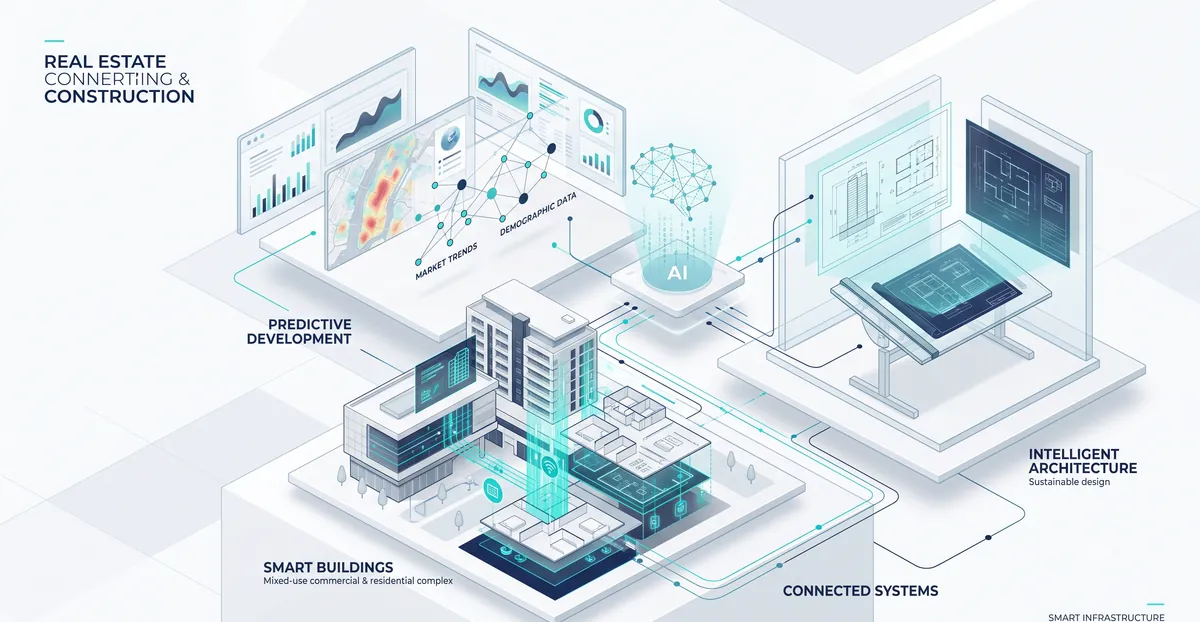
The Context Shaping Real Estate & Construction
Understanding the macro trends and digital priorities driving the need for AI transformation in your sector.
Industry Trends
- Rise of Digital Twins for both construction simulation and facility management.
- Integration of computer vision on job sites for automated progress tracking and safety monitoring.
- Use of AI to navigate complex zoning laws and optimize ESG compliance in new developments.
- Shift towards predictive maintenance in commercial real estate to reduce operational costs.
Digital Priorities
- Standardize data collection across fragmented construction supply chains.
- Implement robust cybersecurity for smart building operational technologies (OT).
- Adopt BIM (Building Information Modeling) fully integrated with AI analytics.
- Upskill project managers to leverage AI scheduling and risk prediction tools.
AI Maturity
The Real Estate and Construction sectors have historically lagged in digital adoption but are now experiencing a rapid catch-up phase. The drive for sustainability (PropTech) and the critical need to control spiraling construction costs (ConTech) are forcing immediate integration of predictive analytics and generative design tools.
The Challenges Shaping the Future of Real Estate & Construction
Strategic barriers preventing organizations from scaling effectively, which AI is uniquely positioned to solve.
Cost Overruns
Construction projects chronically suffer from inaccurate estimating and supply chain delays.
Fragmented Data
Disjointed communication between architects, engineers, contractors, and owners.
Safety Risks
High rates of workplace accidents and compliance violations on physical job sites.
Market Volatility
Fluctuating interest rates and shifting demand patterns impacting real estate valuations.
Where AI Creates the Greatest Business Impact
How enterprise AI capabilities directly address your core challenges to unlock new value and operational efficiency.
Optimized Design
Using AI to rapidly test thousands of architectural permutations for maximum ROI.
Risk Mitigation
Predicting project delays before they happen, allowing for proactive intervention.
Energy Efficiency
Slashing HVAC and lighting costs in commercial real estate via predictive AI control.
Frictionless Transactions
Automating the legal and financial paperwork involved in property sales and leasing.
High-Value AI Use Cases Across the Real Estate & Construction Value Chain
Proven applications driving measurable business value, efficiency, and transformation in Real Estate & Construction.
1Generative Architectural Design
The Problem
Designing floor plans that maximize usable space while adhering to strict zoning and structural codes takes weeks of manual iteration.
The Outcome
Generated optimized floor plans in hours, increasing leasable square footage by up to 5%.
Example Workflow
Architects input parameters (plot size, sunlight orientation, required units), and generative AI outputs hundreds of optimized 3D models and floor plans for review.
2Predictive Property Valuation (AVM)
The Problem
Traditional appraisals are slow, subjective, and often fail to account for hyper-local micro-trends.
The Outcome
Increased valuation accuracy and provided instant pricing for iBuyers and lenders.
Example Workflow
Automated Valuation Models (AVMs) analyze millions of data points, including recent comparable sales, local crime rates, school ratings, and even satellite imagery of roof condition to price a home instantly.
3Automated Construction Progress Tracking
The Problem
Manual site inspections are infrequent and subjective, leading to unnoticed delays and billing disputes with subcontractors.
The Outcome
Reduced schedule overruns by 20% through real-time visibility into project status.
Example Workflow
Drones and helmet-mounted cameras capture daily job site imagery. Computer vision compares the physical progress against the 3D BIM model, automatically updating the project schedule and flagging deviations.
4Predictive Construction Scheduling and Risk
The Problem
Complex dependencies in construction schedules mean one delayed shipment can cascade into massive cost overruns.
The Outcome
Identified high-risk bottlenecks weeks in advance, allowing managers to reroute resources proactively.
Example Workflow
AI analyzes the project schedule alongside external data (weather forecasts, supply chain disruptions, labor availability) to predict the probability of delays and suggest optimal schedule adjustments.
5Smart Building Energy Optimization
The Problem
Commercial buildings waste massive amounts of energy heating and cooling empty spaces or fighting unpredictable weather.
The Outcome
Reduced HVAC energy consumption by 20-30%, significantly lowering operating expenses and carbon footprint.
Example Workflow
AI integrates with the Building Management System (BMS), using weather forecasts, occupancy sensors, and historical thermal data to preemptively adjust HVAC settings minute-by-minute.
6Job Site Safety Monitoring
The Problem
Safety officers cannot monitor a massive construction site 24/7, leading to accidents and OSHA violations.
The Outcome
Reduced workplace accidents by 25% and lowered insurance premiums.
Example Workflow
Computer vision analyzes feeds from site cameras, automatically alerting supervisors in real-time if workers are missing PPE (hard hats, vests) or if heavy machinery is operating too close to personnel.
7Predictive Maintenance for Facilities Management
The Problem
Fixing elevators or HVAC systems after they break disrupts tenants and results in expensive emergency repairs.
The Outcome
Decreased emergency maintenance costs by 40% and improved tenant satisfaction.
Example Workflow
IoT sensors monitor vibration and temperature on critical building equipment. AI predicts component failure before it happens, automatically generating a work order for preventative maintenance.
8AI-Driven Site Selection and Investment Analysis
The Problem
Real estate developers struggle to identify lucrative parcels of land before competitors do.
The Outcome
Identified high-yield investment opportunities faster and with greater confidence.
Example Workflow
Machine learning models analyze demographic shifts, upcoming infrastructure projects, zoning changes, and foot traffic data to predict neighborhood gentrification and recommend optimal development sites.
9Automated Lease Abstraction
The Problem
Commercial landlords with thousands of leases struggle to track critical dates, rent escalations, and complex clauses.
The Outcome
Saved thousands of hours in legal review and prevented missed revenue from rent escalations.
Example Workflow
NLP models ingest unstructured PDF lease documents, automatically extracting key terms (dates, financial obligations, termination rights) and structuring them into the core property management system.
103D Virtual Tours and AI Staging
The Problem
Physical staging is expensive, and static photos fail to capture the potential of an empty or under-construction property.
The Outcome
Increased buyer engagement by 40% and accelerated the sales cycle.
Example Workflow
Generative AI takes photos of an empty room and realistically 'stages' it with various furniture styles (modern, traditional) based on the prospective buyer's demographic profile.
11Supply Chain Material Pricing Prediction
The Problem
Volatile prices for lumber, steel, and concrete make it nearly impossible to guarantee profit margins on long-term construction bids.
The Outcome
Improved bid accuracy and protected profit margins by optimizing the timing of material purchases.
Example Workflow
AI forecasting models analyze global commodities markets, shipping lane data, and geopolitical events to predict the future cost of core building materials over the project lifecycle.
12Tenant Churn Prediction
The Problem
Losing a commercial tenant results in high vacancy costs and expensive tenant improvement (TI) allowances for the next occupant.
The Outcome
Reduced tenant churn by 15% through targeted retention efforts.
Example Workflow
Machine learning analyzes tenant maintenance requests, payment history, and badge-swipe utilization data to identify companies at high risk of not renewing their lease, prompting early landlord intervention.
13Clash Detection in BIM
The Problem
If the HVAC ductwork and electrical conduits are designed to occupy the same physical space, fixing it on the job site costs millions.
The Outcome
Eliminated 90% of physical rework by solving design conflicts digitally before construction begins.
Example Workflow
AI scans combined 3D architectural, structural, and MEP (Mechanical, Electrical, Plumbing) models, automatically highlighting 'clashes' and suggesting routing alternatives.
Risk & Governance
Building Responsible and Trusted AI
Governance in Real Estate and Construction AI bridges physical safety and digital privacy. AI models dictating structural designs must undergo rigorous human engineering validation. On job sites, the use of computer vision for safety tracking must be balanced with worker privacy rights. In smart buildings, securing the IoT networks against cyberattacks is critical to prevent physical hijacking of building systems (e.g., locking doors or shutting off HVAC). Synottic's Responsible AI frameworks ensure that your deployments meet critical standards for security, privacy, and fairness.
ISO 19650 (Organization and digitization of information about buildings/BIM)
OSHA Regulations (Workplace safety compliance)
SOC 2 / ISO 27001 (Data security for PropTech/Smart Buildings)
GDPR / CCPA (Tenant data privacy)
LEED / BREEAM (Sustainability and Environmental Impact)
How Synottic Helps
- 1
AI Readiness Audit
We assess your data infrastructure and governance posture against Real Estate & Construction regulatory standards.
- 2
Guardrails Implementation
Deploy enterprise guardrails to prevent data leakage, bias, and hallucination.
- 3
Continuous Monitoring
Automated drift detection and bias auditing for production models to ensure ongoing compliance.
Your Recommended AI Capability Journey
A structured capability-building roadmap tailored for Real Estate & Construction professionals, from foundational literacy to enterprise-scale AI implementation.
1
Phase 1
Build Foundations
Understand AI terminology, concepts, and responsible use cases specific to Real Estate Construction.
AI Literacy Essentials
1 - 3 Days
Skills Acquired
- Explain core AI concepts in simple business language
- Distinguish AI assistants, copilots, automation and agents
- Write effective prompts using structured frameworks
View Program
Generative AI Essentials
1 - 3 Days
Skills Acquired
- Explain Generative AI in practical business terms
- Understand LLMs and foundation models conceptually
- Select an appropriate AI tool for a given task
View Program
2
Phase 2
Develop Practical Skills
Master generative AI tools to improve daily productivity and communication in Real Estate Construction.
3
Phase 3
Apply AI
Apply AI to function-specific workflows, operations, and strategic planning within Real Estate Construction.
AI for Operations & Supply Chain
1 - 3 Days
Skills Acquired
- Understand AI concepts and practical applications in operations
- Use AI assistants to automate operational activities
- Improve demand forecasting and inventory planning
View Program
AI for Marketing
1 - 3 Days
Skills Acquired
- Understand AI applications across marketing functions
- Use AI assistants to improve daily marketing productivity
- Create effective prompts for content and campaigns
View Program
AI for Customer Service
1 - 3 Days
Skills Acquired
- Apply AI confidently across the customer service lifecycle
- Deliver faster, more personalized customer support
- Reduce response and resolution times using AI assistants
View Program
4
Phase 4
Govern & Scale
Deploy and govern secure, agentic AI systems that comply with Real Estate Construction regulations.
Responsible AI Essentials
1 - 3 Days
Skills Acquired
- Apply Responsible AI principles in everyday work
- Identify and mitigate AI risks
- Evaluate AI systems for fairness and transparency
View Program
AI Agents Essentials
1 - 3 Days
Skills Acquired
- Understand enterprise Agentic AI architectures
- Design AI agent workflows
- Connect AI agents to enterprise systems
View Program
5
Phase 5
Enterprise Capability
Scale AI adoption and build internal capability across your entire Real Estate Construction organization.
The Synottic Transformation Journey
A structured pathway from discovery through to continuous business value, ensuring lasting impact.
1
Discovery
2
Strategize
3
Enable
4
Govern
5
Deploy
6
Scale
How Synottic Helps You Succeed
End-to-end consulting and implementation services designed specifically for Real Estate & Construction.
AI Readiness Assessment
Measure organisational AI maturity and identify strategic capability gaps.
AI Strategy
Align AI initiatives with business goals and operational priorities to maximize ROI.
Executive Advisory
Support senior leaders with AI strategy and long-term transformation planning.
Capability Building
Train your workforce with tailored, role-based AI enablement programs.
Responsible AI & Governance
Establish policies, controls, and ethical frameworks to mitigate AI risks.
Agentic AI & Implementation
Design and deploy autonomous AI agents for complex enterprise processes.
Frequently Asked Questions
No. Generative design AI is a powerful tool for rapid optioneering, creating hundreds of layouts that maximize space and sunlight. However, a licensed human architect is legally required to finalize the design, ensure life-safety codes are met, and provide the aesthetic and cultural context that AI lacks.