Loading…
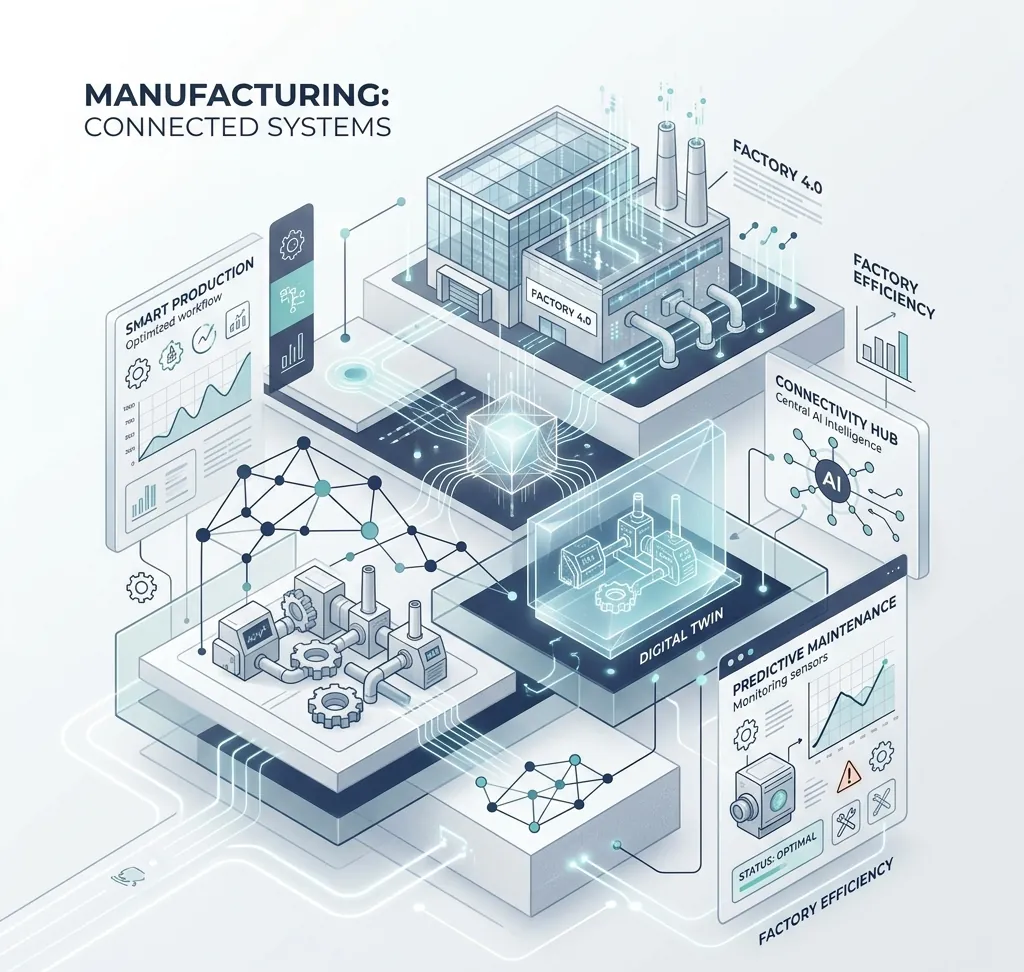
The Context Shaping Manufacturing
Understanding the macro trends and digital priorities driving the need for AI transformation in your sector.
Industry Trends
- Industry 4.0 and the convergence of IT/OT
- Rise of hyper-flexible and autonomous production lines
- Sustainability and energy optimization
- Digital twins encompassing entire supply chains
Digital Priorities
- Connect legacy shop-floor machines to the cloud (IIoT)
- Implement real-time visual inspection systems
- Develop predictive supply chain capabilities
- Upskill the frontline workforce to work alongside AI
AI Maturity
Manufacturing relies heavily on predictive AI and edge computing. Operations have long used statistics, but are now transitioning to deep learning for complex vision tasks and reinforcement learning for process control.
The Challenges Shaping the Future of Manufacturing
Strategic barriers preventing organizations from scaling effectively, which AI is uniquely positioned to solve.
IT/OT Convergence
Bridging modern cloud IT systems with legacy Operational Technology (SCADA/PLC) is difficult.
Data Latency
Cloud computing can be too slow for high-speed manufacturing; edge deployment is required.
Skilled Labor Shortage
An aging workforce is retiring, taking tribal knowledge with them.
Supply Chain Volatility
Global disruptions cause unpredictable shortages of raw materials.
Where AI Creates the Greatest Business Impact
How enterprise AI capabilities directly address your core challenges to unlock new value and operational efficiency.
Zero Defect Manufacturing
Catching 100% of anomalies in real-time.
Energy Optimization
Reducing factory energy consumption through intelligent HVAC and machine control.
Knowledge Capture
Digitizing tribal knowledge into GenAI manuals for new workers.
Dynamic Scheduling
Adapting production schedules instantly based on machine availability.
High-Value AI Use Cases Across the Manufacturing Value Chain
Proven applications driving measurable business value, efficiency, and transformation in Manufacturing.
1Predictive Machine Maintenance
The Problem
Unplanned downtime costs millions and disrupts the entire supply chain.
The Outcome
20% increase in machine uptime and 30% reduction in maintenance costs.
Example Workflow
AI analyzes vibration and acoustic sensor data to predict bearing failures weeks before the machine breaks down.
2Automated Optical Inspection (AOI)
The Problem
Human visual inspection is prone to fatigue, leading to defective products reaching customers.
The Outcome
99.9% defect detection rate on high-speed production lines.
Example Workflow
Computer vision models analyze circuit boards or automotive parts on a conveyor belt, rejecting microscopic defects in milliseconds.
3Supply Chain Demand Forecasting
The Problem
Relying on historical sales data fails during volatile market conditions.
The Outcome
Optimized inventory levels, reducing holding costs by 15%.
Example Workflow
Machine learning models ingest macroeconomic indicators, weather data, and social trends to forecast hyper-local demand for products.
4Generative Design for Parts
The Problem
Traditional engineering design processes are slow and often produce sub-optimal, heavy parts.
The Outcome
Lighter, stronger parts and reduced material costs.
Example Workflow
Engineers input constraints (weight, materials) into a GenAI tool, which generates hundreds of optimized 3D CAD designs.
5Process Parameter Optimization
The Problem
Complex processes (like injection molding or chemical refining) have thousands of variables that are hard to tune manually.
The Outcome
Increased yield and reduced scrap rates.
Example Workflow
Reinforcement learning continuously adjusts temperature and pressure settings in real-time to optimize product quality.
6Digital Twin of the Factory Floor
The Problem
Reconfiguring a factory layout for a new product line is risky and expensive.
The Outcome
Zero disruption during physical factory reconfigurations.
Example Workflow
A 3D digital twin simulates the impact of moving machines or changing workflows before any physical changes are made.
7Energy Management and Decarbonization
The Problem
Manufacturing plants consume massive amounts of energy, driving up costs and carbon footprints.
The Outcome
15% reduction in energy consumption.
Example Workflow
AI predicts peak energy usage times and dynamically adjusts non-critical machinery and HVAC systems to shave peak loads.
8Collaborative Robotics (Cobots)
The Problem
Traditional industrial robots are dangerous and must be caged, limiting flexibility.
The Outcome
Safe, flexible human-machine collaboration on the assembly line.
Example Workflow
AI-equipped cobots use spatial awareness to safely assist human workers with heavy lifting or precision assembly tasks.
9Dynamic Production Scheduling
The Problem
Static ERP schedules fall apart when a machine goes down or a critical part is delayed.
The Outcome
Maximized factory throughput and on-time delivery.
Example Workflow
AI continuously re-optimizes shop floor schedules, routing work-in-progress to available machines dynamically.
10Supplier Risk Management
The Problem
Tier-2 and Tier-3 supplier vulnerabilities are often hidden until a crisis hits.
The Outcome
Proactive mitigation of supply chain disruptions.
Example Workflow
NLP engines scan global news, financial reports, and geopolitical events to flag risks in the extended supply network.
11GenAI Maintenance Assistants
The Problem
Junior technicians struggle to troubleshoot complex legacy machinery without senior guidance.
The Outcome
Faster mean-time-to-repair (MTTR).
Example Workflow
Technicians chat with a tablet-based GenAI trained on decades of machine manuals and maintenance logs to get step-by-step repair instructions.
12Scrap and Yield Analysis
The Problem
Identifying the root cause of systemic defects across multiple production stages is like finding a needle in a haystack.
The Outcome
Elimination of chronic quality issues.
Example Workflow
Data models correlate final product failures back to specific raw material batches or machine operators to pinpoint root causes.
Risk & Governance
Building Responsible and Trusted AI
In manufacturing, AI governance focuses heavily on physical safety, edge computing security, and operational reliability. Models controlling heavy machinery must have deterministic failsafes. Synottic's Responsible AI frameworks ensure that your deployments meet critical standards for security, privacy, and fairness.
ISO 27001
IEC 62443 (Industrial Cybersecurity)
OSHA regulations
ISO 9001
How Synottic Helps
- 1
AI Readiness Audit
We assess your data infrastructure and governance posture against Manufacturing regulatory standards.
- 2
Guardrails Implementation
Deploy enterprise guardrails to prevent data leakage, bias, and hallucination.
- 3
Continuous Monitoring
Automated drift detection and bias auditing for production models to ensure ongoing compliance.
Your Recommended AI Capability Journey
A structured capability-building roadmap tailored for Manufacturing professionals, from foundational literacy to enterprise-scale AI implementation.
1
Phase 1
Build Foundations
Understand AI terminology, concepts, and responsible use cases specific to Manufacturing.
2
Phase 2
Develop Practical Skills
Master generative AI tools to improve daily productivity and communication in Manufacturing.
3
Phase 3
Apply AI
Apply AI to function-specific workflows, operations, and strategic planning within Manufacturing.
AI for Operations & Supply Chain
1 - 3 Days
Skills Acquired
- Understand AI concepts and practical applications in operations
- Use AI assistants to automate operational activities
- Improve demand forecasting and inventory planning
View Program
AI for Procurement
1 - 3 Days
Skills Acquired
- Understand AI concepts relevant to procurement and supply chain
- Apply Prompt Engineering to procurement workflows
- Generate procurement documentation, RFQs, RFPs and communications
View Program
4
Phase 4
Govern & Scale
Deploy and govern secure, agentic AI systems that comply with Manufacturing regulations.
5
Phase 5
Enterprise Capability
Scale AI adoption and build internal capability across your entire Manufacturing organization.
The Synottic Transformation Journey
A structured pathway from discovery through to continuous business value, ensuring lasting impact.
1
Discovery
2
Strategize
3
Enable
4
Govern
5
Deploy
6
Scale
How Synottic Helps You Succeed
End-to-end consulting and implementation services designed specifically for Manufacturing.
AI Readiness Assessment
Measure organisational AI maturity and identify strategic capability gaps.
AI Strategy
Align AI initiatives with business goals and operational priorities to maximize ROI.
Executive Advisory
Support senior leaders with AI strategy and long-term transformation planning.
Capability Building
Train your workforce with tailored, role-based AI enablement programs.
Responsible AI & Governance
Establish policies, controls, and ethical frameworks to mitigate AI risks.
Agentic AI & Implementation
Design and deploy autonomous AI agents for complex enterprise processes.
Frequently Asked Questions
Edge AI processes data locally on the machine rather than in the cloud. It is crucial for high-speed use cases (like safety stops or visual inspection) where cloud latency is unacceptable.