Loading…
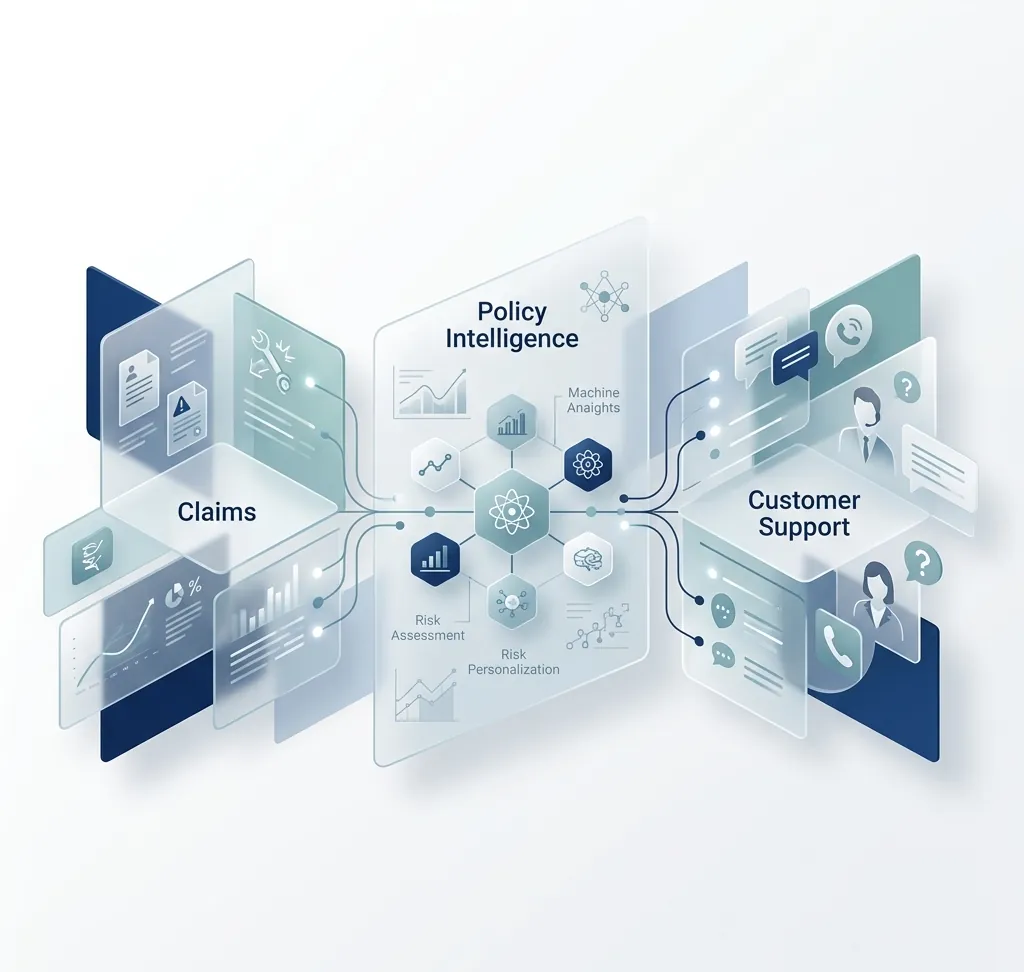
The Context Shaping Insurance
Understanding the macro trends and digital priorities driving the need for AI transformation in your sector.
Industry Trends
- Telematics and usage-based insurance (UBI)
- Proactive risk prevention rather than reactive payouts
- Seamless omnichannel customer journeys
- Integration of IoT in property and casualty (P&C)
Digital Priorities
- Modernize legacy policy administration systems
- Enable straight-through processing (STP) for claims
- Leverage unstructured data for risk assessment
- Develop agile product launch capabilities
AI Maturity
The insurance industry is rapidly adopting AI, moving from basic optical character recognition (OCR) towards advanced cognitive underwriting and automated claims adjusting. AI is becoming central to competitive pricing and risk mitigation.
The Challenges Shaping the Future of Insurance
Strategic barriers preventing organizations from scaling effectively, which AI is uniquely positioned to solve.
Complex Legacy Architecture
Siloed, decades-old systems hinder agile data deployment and integrations.
Data Quality and Access
Valuable historical claims data is often unstructured, trapped in PDFs or notes.
Rising Fraud Costs
Sophisticated organized fraud rings exploit traditional, manual verification processes.
Regulatory Stringency
Strict rate and form filing laws require models to be perfectly explainable.
Where AI Creates the Greatest Business Impact
How enterprise AI capabilities directly address your core challenges to unlock new value and operational efficiency.
Automated Underwriting
Instant policy quoting using alternative data and predictive risk models.
Claims Straight-Through Processing
Resolving simple claims in minutes without human intervention.
Predictive Maintenance
Using IoT data to warn policyholders before losses occur.
Personalized Product Bundling
Recommending tailored coverage based on life events and behavioral data.
High-Value AI Use Cases Across the Insurance Value Chain
Proven applications driving measurable business value, efficiency, and transformation in Insurance.
1Intelligent Claims Triage
The Problem
Manual sorting of claims delays processing times and ties up senior adjusters on low-complexity cases.
The Outcome
40% reduction in claims processing time and improved adjuster allocation.
Example Workflow
NLP models read First Notice of Loss (FNOL) documents to assess complexity and route simple claims to automated workflows.
2Damage Estimation via Computer Vision
The Problem
Physical vehicle or property inspections are slow, costly, and subject to human inconsistency.
The Outcome
50% faster estimate generation and reduced appraisal costs.
Example Workflow
Computer vision analyzes photos of a crashed car or damaged roof to instantly estimate repair costs and order parts.
3Predictive Fraud Scoring
The Problem
Fraudulent claims cost billions, and manual investigation is slow and inconsistent.
The Outcome
25% increase in fraud detection accuracy and reduction in false positives.
Example Workflow
Machine learning algorithms evaluate claims against thousands of variables to assign a real-time fraud probability score.
4Dynamic Pricing and Telematics
The Problem
Traditional proxy variables (age, zip code) for pricing are blunt instruments.
The Outcome
More competitive pricing leading to a 15% increase in market share among low-risk drivers.
Example Workflow
IoT models analyze real-time driving behavior (braking, acceleration) to adjust premiums continuously.
5Next-Gen Underwriting Engine
The Problem
Underwriters spend too much time gathering data rather than analyzing complex risks.
The Outcome
30% increase in underwriter capacity and faster policy issuance.
Example Workflow
AI aggregates medical records, geospatial data, and credit history to synthesize a holistic risk profile.
6Customer Churn Prediction
The Problem
Losing a policyholder is costly, but identifying dissatisfied customers before renewal is difficult.
The Outcome
10% improvement in policy retention rates.
Example Workflow
Predictive models identify early warning signs of churn (e.g., negative call sentiment, competitor searches) to prompt retention efforts.
7Automated Policy Document Generation
The Problem
Drafting custom commercial policies is error-prone and labor-intensive.
The Outcome
Reduction in drafting errors and 60% faster policy issuance.
Example Workflow
GenAI drafts customized contract clauses based on the underwritten parameters and regulatory constraints.
8Natural Disaster Risk Modeling
The Problem
Climate change is rendering historical actuarial tables obsolete for property insurance.
The Outcome
More accurate catastrophic risk reserves and pricing.
Example Workflow
AI processes satellite imagery and climate simulations to predict hyperlocal wildfire or flood risks.
9Life Insurance Medical Record Summarization
The Problem
Reviewing hundreds of pages of Attending Physician Statements (APS) causes massive delays.
The Outcome
Reduction in review time from days to minutes.
Example Workflow
GenAI extracts relevant medical conditions, medications, and risk factors into a concise summary for the underwriter.
10Conversational FNOL Intake
The Problem
Customers experiencing a loss are stressed and frustrated by complex intake forms or long hold times.
The Outcome
Higher customer satisfaction and more accurate initial data capture.
Example Workflow
Voice and chat AI guide distressed customers through the claims reporting process, offering empathy and extracting structured data.
11Subrogation Identification
The Problem
Missed subrogation opportunities cost insurers significant revenue recovery.
The Outcome
15% increase in subrogation recovery funds.
Example Workflow
Text mining algorithms scan claims adjuster notes and police reports to flag cases where third parties are liable.
12Workers' Compensation Severity Prediction
The Problem
Early intervention is critical in workers' comp, but identifying which claims will escalate is tough.
The Outcome
Reduced long-term disability payouts and faster return-to-work rates.
Example Workflow
Predictive models analyze initial injury reports and medical codes to flag claims likely to result in chronic pain or litigation.
Risk & Governance
Building Responsible and Trusted AI
Insurance AI models must be highly transparent. Algorithms that determine pricing or coverage are scrutinized for discriminatory bias, requiring clear audit trails for regulatory bodies. Synottic's Responsible AI frameworks ensure that your deployments meet critical standards for security, privacy, and fairness.
NAIC AI Guidelines
GDPR
HIPAA (for health data)
State-specific DOI regulations
How Synottic Helps
- 1
AI Readiness Audit
We assess your data infrastructure and governance posture against Insurance regulatory standards.
- 2
Guardrails Implementation
Deploy enterprise guardrails to prevent data leakage, bias, and hallucination.
- 3
Continuous Monitoring
Automated drift detection and bias auditing for production models to ensure ongoing compliance.
Your Recommended AI Capability Journey
A structured capability-building roadmap tailored for Insurance professionals, from foundational literacy to enterprise-scale AI implementation.
1
Phase 1
Build Foundations
Understand AI terminology, concepts, and responsible use cases specific to Insurance.
2
Phase 2
Develop Practical Skills
Master generative AI tools to improve daily productivity and communication in Insurance.
3
Phase 3
Apply AI
Apply AI to function-specific workflows, operations, and strategic planning within Insurance.
4
Phase 4
Govern & Scale
Deploy and govern secure, agentic AI systems that comply with Insurance regulations.
Responsible AI Essentials
1 - 3 Days
Skills Acquired
- Apply Responsible AI principles in everyday work
- Identify and mitigate AI risks
- Evaluate AI systems for fairness and transparency
View Program
AI Agents Essentials
1 - 3 Days
Skills Acquired
- Understand enterprise Agentic AI architectures
- Design AI agent workflows
- Connect AI agents to enterprise systems
View Program
5
Phase 5
Enterprise Capability
Scale AI adoption and build internal capability across your entire Insurance organization.
The Synottic Transformation Journey
A structured pathway from discovery through to continuous business value, ensuring lasting impact.
1
Discovery
2
Strategize
3
Enable
4
Govern
5
Deploy
6
Scale
How Synottic Helps You Succeed
End-to-end consulting and implementation services designed specifically for Insurance.
AI Readiness Assessment
Measure organisational AI maturity and identify strategic capability gaps.
AI Strategy
Align AI initiatives with business goals and operational priorities to maximize ROI.
Executive Advisory
Support senior leaders with AI strategy and long-term transformation planning.
Capability Building
Train your workforce with tailored, role-based AI enablement programs.
Responsible AI & Governance
Establish policies, controls, and ethical frameworks to mitigate AI risks.
Agentic AI & Implementation
Design and deploy autonomous AI agents for complex enterprise processes.
Frequently Asked Questions
AI excels at data extraction and triaging, while complex edge cases are always escalated to human adjusters in a 'human-in-the-loop' system.