Loading…
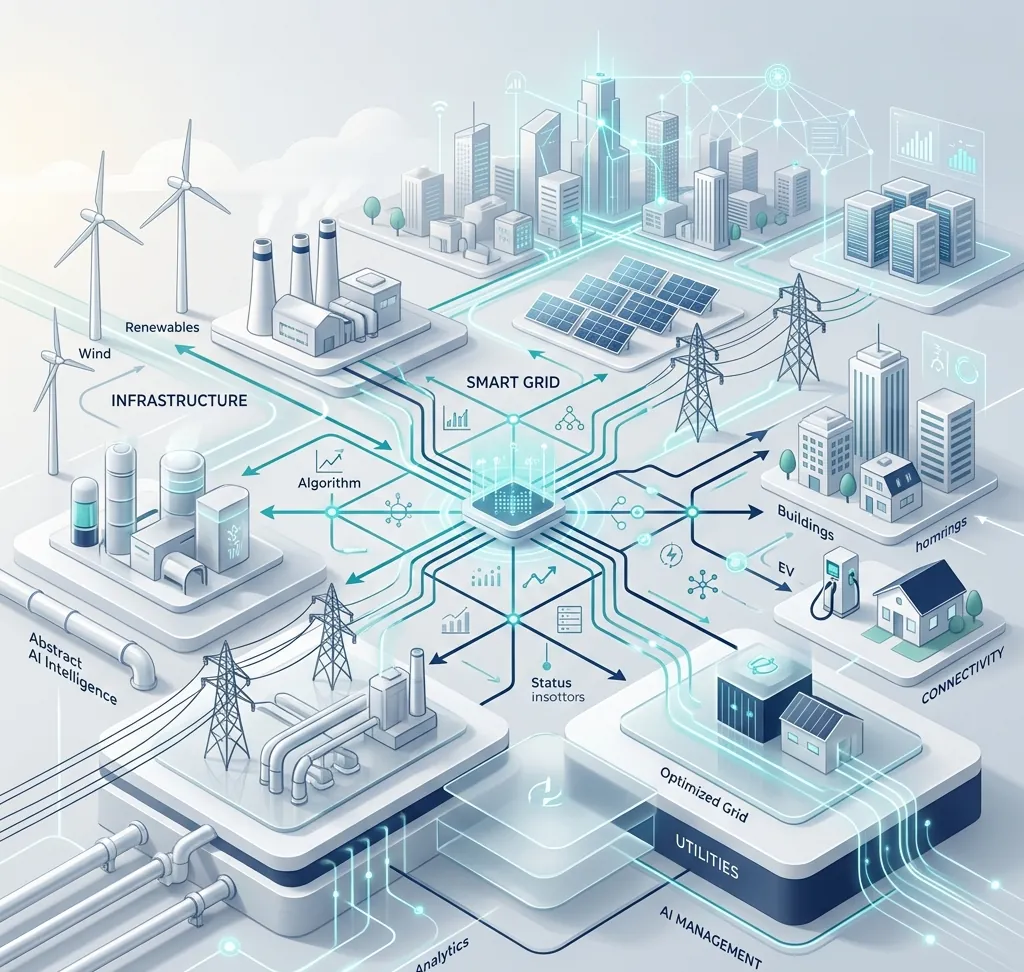
The Context Shaping Energy & Utilities
Understanding the macro trends and digital priorities driving the need for AI transformation in your sector.
Industry Trends
- Decarbonization and the transition to renewable energy sources
- Electrification of transport and heating
- Decentralization of power generation with microgrids
- Increasing frequency of extreme weather events impacting grid resilience
Digital Priorities
- Deploying advanced metering infrastructure (AMI)
- Implementing IT/OT convergence for real-time operations
- Leveraging predictive analytics for asset health
- Building robust cybersecurity postures for critical infrastructure
AI Maturity
The energy and utilities sector is transitioning from foundational analytics to advanced AI. Early adopters are realizing significant gains in predictive maintenance and grid balancing, while the broader industry is scaling up AI investments to meet decarbonization and resilience mandates.
The Challenges Shaping the Future of Energy & Utilities
Strategic barriers preventing organizations from scaling effectively, which AI is uniquely positioned to solve.
Aging Infrastructure
Managing and maintaining legacy assets that are prone to failure and difficult to monitor.
Intermittent Renewables
Balancing the grid with variable generation from solar and wind sources.
Cybersecurity Threats
Protecting critical national infrastructure against increasingly sophisticated cyber attacks.
Regulatory Compliance
Navigating complex and evolving environmental and energy regulations.
Where AI Creates the Greatest Business Impact
How enterprise AI capabilities directly address your core challenges to unlock new value and operational efficiency.
Predictive Asset Management
Reducing unplanned outages and extending asset life through AI-driven insights.
Intelligent Grid Operations
Optimizing power flow and integrating distributed energy resources efficiently.
Demand Response Optimization
Engaging customers to shift loads and balance grid demand using dynamic pricing.
Vegetation Management
Using computer vision to monitor power lines and prevent wildfire risks.
High-Value AI Use Cases Across the Energy & Utilities Value Chain
Proven applications driving measurable business value, efficiency, and transformation in Energy & Utilities.
1Predictive Maintenance for Transformers
The Problem
Unexpected transformer failures cause localized outages, high replacement costs, and potential safety hazards.
The Outcome
Reduces unplanned outages by up to 30% and extends transformer lifecycle.
Example Workflow
Machine learning models analyze DGA (dissolved gas analysis) data, temperature sensors, and load history to predict failure probabilities weeks in advance.
2AI-Driven Vegetation Management
The Problem
Trees and vegetation interfering with power lines are a leading cause of outages and wildfires.
The Outcome
Cuts vegetation management costs by 20% and significantly reduces fire risks.
Example Workflow
Computer vision algorithms process satellite imagery and LiDAR data to identify vegetation encroachment and prioritize trimming schedules.
3Wind Turbine Anomaly Detection
The Problem
Offshore and remote wind turbines are expensive to inspect and maintain, leading to prolonged downtime.
The Outcome
Increases turbine availability by 5-10% and optimizes maintenance crew dispatch.
Example Workflow
Acoustic sensors and vibration data are fed into AI models to detect gearbox anomalies before catastrophic failure occurs.
4Solar Forecasting Optimization
The Problem
Cloud cover and weather variability make solar generation highly unpredictable, complicating grid balancing.
The Outcome
Improves day-ahead forecasting accuracy by 15%, reducing the need for fossil-fuel spinning reserves.
Example Workflow
Deep learning networks combine local weather forecasts, sky cameras, and historical generation data to predict solar output in 15-minute intervals.
5Smart Meter Data Analytics for Load Disaggregation
The Problem
Utilities lack visibility into behind-the-meter appliance usage, limiting targeted energy efficiency programs.
The Outcome
Increases customer engagement and improves targeted program adoption rates by 25%.
Example Workflow
AI algorithms process high-frequency AMI data to disaggregate total household load into specific appliance usage without requiring plug-level sensors.
6Theft and Non-Technical Loss Detection
The Problem
Energy theft and faulty meters cost utilities billions in unbilled revenue annually.
The Outcome
Recovers 1-3% of total revenue through targeted field inspections.
Example Workflow
Anomaly detection models flag suspicious consumption patterns, bypassing physical tampers by correlating expected vs. actual usage.
7Grid Congestion Management
The Problem
Increasing EV adoption and distributed generation cause localized bottlenecks in distribution networks.
The Outcome
Defers capital-intensive grid upgrades while maintaining reliability.
Example Workflow
Reinforcement learning models dynamically adjust voltage and re-route power flows to alleviate congestion points in real-time.
8Dynamic Pricing and Demand Response
The Problem
Fixed tariffs fail to incentivize customers to shift consumption away from peak demand periods.
The Outcome
Shifts 5-10% of peak load, reducing the need for peaker plant activation.
Example Workflow
AI predicts individual customer price elasticity to offer personalized, time-of-use incentives via mobile apps.
9Water Leakage Detection
The Problem
Non-revenue water lost through undetected leaks in aging pipe networks is a massive resource waste.
The Outcome
Reduces non-revenue water by up to 40% and prevents catastrophic main bursts.
Example Workflow
Acoustic loggers and pressure sensors feed data into neural networks that pinpoint leak locations to within a few meters.
10Customer Churn Prediction in Deregulated Markets
The Problem
High customer acquisition costs are wasted when customers switch to competitors in open markets.
The Outcome
Reduces churn rates by 15% through proactive retention strategies.
Example Workflow
Propensity models analyze billing history, customer service interactions, and market pricing to identify at-risk customers and trigger retention offers.
11Outage Prediction and Restoration Routing
The Problem
Extreme weather causes widespread outages, and routing repair crews efficiently is a complex logistical challenge.
The Outcome
Reduces System Average Interruption Duration Index (SAIDI) by 10-15%.
Example Workflow
AI predicts specific outage locations during a storm based on weather tracks and asset vulnerability, then optimizes real-time routing for field crews.
12Energy Trading Optimization
The Problem
Volatile wholesale energy markets require split-second decisions to maximize profitability and hedge risks.
The Outcome
Increases trading margins by 5% and reduces risk exposure.
Example Workflow
Algorithmic trading bots use natural language processing to ingest news sentiment alongside market data to execute high-frequency trades.
Risk & Governance
Building Responsible and Trusted AI
The Energy & Utilities sector is heavily regulated, ensuring the continuous and safe supply of critical services. AI applications must adhere to strict cybersecurity standards to protect critical infrastructure, alongside data privacy regulations for consumer information. Synottic's Responsible AI frameworks ensure that your deployments meet critical standards for security, privacy, and fairness.
NERC CIP (North American Electric Reliability Corporation Critical Infrastructure Protection)
GDPR (General Data Protection Regulation) for customer data
ISO 27001 for Information Security Management
NIST Cybersecurity Framework
How Synottic Helps
- 1
AI Readiness Audit
We assess your data infrastructure and governance posture against Energy & Utilities regulatory standards.
- 2
Guardrails Implementation
Deploy enterprise guardrails to prevent data leakage, bias, and hallucination.
- 3
Continuous Monitoring
Automated drift detection and bias auditing for production models to ensure ongoing compliance.
Your Recommended AI Capability Journey
A structured capability-building roadmap tailored for Energy & Utilities professionals, from foundational literacy to enterprise-scale AI implementation.
1
Phase 1
Build Foundations
Understand AI terminology, concepts, and responsible use cases specific to Energy Utilities.
AI Literacy Essentials
1 - 3 Days
Skills Acquired
- Explain core AI concepts in simple business language
- Distinguish AI assistants, copilots, automation and agents
- Write effective prompts using structured frameworks
View Program
Generative AI Essentials
1 - 3 Days
Skills Acquired
- Explain Generative AI in practical business terms
- Understand LLMs and foundation models conceptually
- Select an appropriate AI tool for a given task
View Program
2
Phase 2
Develop Practical Skills
Master generative AI tools to improve daily productivity and communication in Energy Utilities.
3
Phase 3
Apply AI
Apply AI to function-specific workflows, operations, and strategic planning within Energy Utilities.
AI for Operations & Supply Chain
1 - 3 Days
Skills Acquired
- Understand AI concepts and practical applications in operations
- Use AI assistants to automate operational activities
- Improve demand forecasting and inventory planning
View Program
AI for Marketing
1 - 3 Days
Skills Acquired
- Understand AI applications across marketing functions
- Use AI assistants to improve daily marketing productivity
- Create effective prompts for content and campaigns
View Program
AI for Customer Service
1 - 3 Days
Skills Acquired
- Apply AI confidently across the customer service lifecycle
- Deliver faster, more personalized customer support
- Reduce response and resolution times using AI assistants
View Program
4
Phase 4
Govern & Scale
Deploy and govern secure, agentic AI systems that comply with Energy Utilities regulations.
Responsible AI Essentials
1 - 3 Days
Skills Acquired
- Apply Responsible AI principles in everyday work
- Identify and mitigate AI risks
- Evaluate AI systems for fairness and transparency
View Program
AI Agents Essentials
1 - 3 Days
Skills Acquired
- Understand enterprise Agentic AI architectures
- Design AI agent workflows
- Connect AI agents to enterprise systems
View Program
5
Phase 5
Enterprise Capability
Scale AI adoption and build internal capability across your entire Energy Utilities organization.
The Synottic Transformation Journey
A structured pathway from discovery through to continuous business value, ensuring lasting impact.
1
Discovery
2
Strategize
3
Enable
4
Govern
5
Deploy
6
Scale
How Synottic Helps You Succeed
End-to-end consulting and implementation services designed specifically for Energy & Utilities.
AI Readiness Assessment
Measure organisational AI maturity and identify strategic capability gaps.
AI Strategy
Align AI initiatives with business goals and operational priorities to maximize ROI.
Executive Advisory
Support senior leaders with AI strategy and long-term transformation planning.
Capability Building
Train your workforce with tailored, role-based AI enablement programs.
Responsible AI & Governance
Establish policies, controls, and ethical frameworks to mitigate AI risks.
Agentic AI & Implementation
Design and deploy autonomous AI agents for complex enterprise processes.
Frequently Asked Questions
AI improves grid resilience by predicting equipment failures before they happen, dynamically managing power flows to avoid overloads, and optimizing the integration of renewable energy sources to maintain stability.